Remembering the Melodies

Photo by Pixabay on Pexels.com

The Poor are Always with Us

Rudeness Amidst the Holiday Cheer

Battle Weary

Written sometime in 2014, when I was still a minister, trying to figure out what I was going to do with my life.

I don’t like to be categorized. I grew up with fundamentalists I still love but have difficulty being friends with them. I don’t always like being pegged as a liberal theologian because there’s a lot of intellectual crap that comes from that camp, too. And while I resonate with many atheists these days, so many of them are just plain assholes, I’m sorry to say. 

There’s no way to have a real conversation with folks in any of these groups. Everything is reduced to angry arguments, and no one is allowed to think. Every camp would try to define me in ways that are not accurate, even while I’m still sussing out what I think.

I can’t accept the image of the all-knowing, violent, but benevolent daddy of the heavens. But I still think there may be a spiritual component to life, and I’d like to inch my way through the darkness to find out about it, assuming it exists. And I’d like to do it without having to defend myself against multiple opponents.

I’m tired of conflict with people in church, theology, politics, and social justice issues. The battles in these arenas aren’t what I want to spend my time on. But I still want to help people. 

But I need to convalesce for a while. Is that possible? Could loved ones and enemies alike leave me alone for just a while? I want to sit in the dark, away from all the craziness and violence that rages inside and outside of me, and have some quiet. 

But I’m also tired of being alone, so… could I have some gentle people around me who like conversation, would share music, and look at art with me? 

I wouldn’t do it for the rest of my life. There’s still fire in the belly, and someone will always need help. I want to be there for them.    

But could I please rest a while? 

************************************************************

Addendum:

Nine years later, I’ve gotten some rest, and Sylvia shares conversation, music, and art with me. For someone who said he was tired, I have to admit that I like getting into a good argument these days. However, I’d much rather have good conversation.

But Without Faith, It is Impossible to Have Religion

“I don’t have enough faith to be an atheist.”

I hear this from time to time, and it makes me sigh as I try to answer as respectfully as possible. Here’s my best effort: 

“As an atheist,” I say, “I have no faith at all. Instead, I look for truth through direct examination and critical thought.” 

It took a few years to get comfortable with the term “atheist.” I was raised to equate atheism with evil, and I had to summon my courage to come out and say I was one.

I finally got past the discomfort. However, I’m still not particularly satisfied with the term because I don’t like defining myself by what I don’t think. 

My values define me better. 

I often call myself a humanist because I value people and have spent my life helping them when possible. I value qualities that aid in the betterment of humanity, such as compassion, bravery, and generosity. I also love humor, beauty, passion, creativity, and human connection. 

I value gentleness, truth, and love, and I think those qualities can’t exist unless they are connected with each other. I hate lying and greed, which are also often associated with each other. I’m outraged by poverty, cruelty, unfairness, and violence. 

I value the scientific process, although I leaned more toward the humanities in school. I support education that teaches critical thinking, which can lead people to confront fallacies, correct mistakes, and motivate them to grow. I ask questions and engage in critical thought, and I appreciate clarity but leave room for discovery and possibility. 

Proponents of religions claim to promote virtue and wisdom, which, if true, would lead them to value many of the same things I do. But instead, they are often threatened if confronted by facts that challenge their assumptions based on their faith, and their fear can lead to denial, anger, and even violence.  

Some say my atheism is a form of religion. I don’t think so, but for the sake of discussion, if I were to establish a religion, here’s what it would include: 

First, no evangelism. By all means, let’s discuss, persuade each other, and even argue. But combining the promise of love with the threat of condemnation is manipulation, and even brainwashing.

Second, I enjoy watching events unfold, so I don’t need to guess the future and call it prophecy.   

Next, I welcome empirical study but not groundless faith.

Most religions establish rules for moral conduct. I realize that society must have various forms of legislation, and I am content to let the established entities continue to hammer those out, sometimes with my participation. But my religion does not have elaborate doctrinal laws to inflict on others. As a minister, I expended a ton of energy telling people what to think and do, but my new religion requires respecting people’s right to have their own thoughts and make their own decisions. 

Grammerly has just informed me that I’ve used the word “religion” too many times in this text, and I agree. This is why I left it behind for a life where I help others, observe what’s happening, and watch for what happens next.  

So a religion with no faith is no religion, and that suits me fine.

Nearly Done

This time I visit myself not long ago while I was still on the job

On a Sunday afternoon after church, the old pastor goes to the hospital to sit with the new widow.  Her husband, who suffered lifelong depression, had just carried out an oft-repeated threat and shot himself.

The pastor steps into the room and sees her sitting by the bed where the body lies, his head wrapped in a bloody rag. The Pastor sits next to her and listens as she shares the untold story of her watching him constantly over the years. If she went anywhere–the store or to church–she hurried back as fast as she could. On this occasion, the husband didn’t give her enough time to get back.    

They sit with the body for hours.  It takes all afternoon for the hospital, the funeral director, and the coroner to tend to the business of this man’s death. Eventually, the time and place of the funeral are set.

Before they take the body, the pastor stands over it and touches his arm. 

“I wish I had known,” he whispers.  “I’m sorry I didn’t help you.”

As the sun sets, everyone leaves the hospital.  As he drives home, the pastor prepares himself for the question the widow will ask him once the funeral is over, the relatives go home, and the shock has worn off:   

“Did my husband go to hell?”

He has had to answer that question many times over the years. He will take the widow’s hand and say quietly, “No, my friend. God does not punish anyone for being ill. Your husband has suffered enough and now is safe with Jesus.”

He doesn’t believe in God or heaven or hell anymore, but she’ll need to hear the words. 

He pulls into the garage. No one else is home. He changes clothes and sits in his recliner as the darkness of the evening sets in. After thirty-five years of this work, the pastor is exhausted and numb.

“Hang on,” I whisper to him, “You’re nearly done.”

Encouraging My Younger Self

I’m trying something a little different. Writing about my memories as a pastor has been difficult. I tend to relive the pain of the experiences. But I heard something yesterday that made me try to imagine going back as the person I am now to support the person I was back then.

This harkens back to a post I wrote here.

The young pastor had driven the ambulance to the scene and wore the white smock of the volunteer emergency service. He watched as people flailed their shovels into a ton of fertilizer to find their friend who was buried underneath.  The man was going to be dead when they found him, but they worked feverishly with the scant hope that they might yet save him. Two burly young men, the man’s sons, with shovels still in their hands, watched as their father’s body was pulled out.

The pastor also served as a chaplain in situations like these. As he watched the people run and shout and try and fail and cry, he found himself about to burst into tears. But he realized he had to try to comfort them all, including those two young men.  So he swallowed hard and went to work, speaking to the sons, hugging them both. The rest of the afternoon, he listened to the people who had been there and needed to process their shock. 

The pastor was twenty-four years old. 

I go to him and stand invisible beside him. 

“I’m here,” I whisper to him as he watches from the sidelines. “You don’t know it but I’m putting my arms around you and holding you together.

“This is a defining moment for you,” I continue. “You want to run away, but instead you will step into the chaos and try to heal the people who have just been shattered.

“You already know that you have no words, no special skills, and no magic to make it better.  But you’ll still step into the fray to help. You’ll do this over and over again, year after year, when you’re exhausted, sad, and even very sick.”

I point to the people and say, “They don’t know the price you’ll pay. They don’t know how lonely you are and that you feel like a failure.  But you’re the hero of this story.

“Now it’s time to go to work.”

I let him go and watch him wade into the crowd.

Performing a Wiccan Wedding: A Change in Perspective

I stopped in a church parking lot and got off the motorcycle to stretch my legs and get my bearings. A car pulled up beside me and the passenger window rolled down. The older gentleman at the wheel leaned over to speak to me.

“I’m the pastor of this church,” he said. Can I help you with anything?”

“No thanks,” I said. “I’m just taking a break.”

“I’m a retired minister, myself,” I continued. “I’m on my way to perform a wedding ceremony.”

He brightened when he realized he was talking to a colleague. We chatted and traded pedigrees.  He was a preacher for an Independent Fundamentalist Baptist Church–very conservative.  I told him where I was educated and confessed I was on the liberal end of the spectrum, although I chose not to reveal that I was now an atheist humanist celebrant. We were cordial and wished each other well as I glided away on the bike.

I also neglected to tell him I would be performing my first Wiccan wedding.

I reached the park and met with the wedding party and their families.  They were a little stressed as most wedding participants are, but they were also pleasant and kind. The young man was tall, slender, and perhaps shy. I helped him straighten his tie and I took the opportunity to clasp his shoulders and say he was a handsome young man. The beautiful young woman had long hair and wore a simple but elegant dress. The party also included a small adorable baby girl. 

It was my first Wiccan ceremony, and although I once taught World Religions in college, I had to study up on the proceedings.  We conducted the ceremony by a luminescent spring.

Green Springs Park, by David Mercer

The woman laid out a circle of small rocks around us.  The father of the bride handed the young man a small knife (called an athame) as a symbolic act of passing the responsibility of protecting his daughter to the man who would be her husband. In the handfasting ritual, I wrapped a thin rope loosely around the bride and groom’s wrists. When they pulled their hands away, they held onto the ends of the rope, forming a knot in the middle. Near the end, they jumped over a broom to signify stepping into a new life.

While the baby gurgled, they offered each other their vows using words like love, community, life forces, eternity, magic, the sun, moon, land, and sea. At the end, I pronounced them married and they kissed each other.

The preacher I met earlier would be obligated to believe these proceedings were evil, which is preposterous. They are a lovely couple, joining hands to make their way in life. They value the qualities of wonder, love, and each other. They embrace the idea of making the world a better place. And they are kind and gracious.

When I was a young conservative preacher, I often said Wiccan was evil, which I see now is preposterous. I regret that I might have caused someone to feel pain from my words. I’m glad I’m in a different place where I get to participate in the formalized union of this sweet little family.

Green Springs Park by David Mercer

Throwing Away the Script

“I need to get to church this Sunday,” my new friend said. “I’ve missed it lately and I need to get back. My whole week goes so much better when I go to church.” 

She’s a little older than me. Sweet… funny… kind.  As we chatted,  I nodded to show I was listening to her. 

Then she asked me: “Do you go to church?”

My head changed from going up and down to back and forth.

“Why not?” she asked, surprised

I gave a smile and a shrug.

She gave me her disapproving look. “You need to go,” she said.

I continued to smile and not answer.

“WHY don’t you go to church?” she said.

Not long ago, I would have told her I was an atheist, that I used to go to church, and in fact, I was a preacher, but now I have had enough of religion. Instead, I said gently.  “I don’t want to.” which prompted her to sputter.     

Bible Belters follow a script for moments like this but I was opting out of it.    

I could have said:

“I’ve been meaning to get back to church.”

She would have considered it an acceptable response but it ran the risk of prompting her to invite me to her church. Then I would have had to lie and say, “Thanks, I’ll try to make it sometime.” I’d never have any intention of doing so but she would feel better for having made an effort.   

But, like I said, I didn’t feel like following the script.

 “Didn’t you go when you were a kid?” she pressed.

“Yes. My dad was a preacher,” I volunteered.  “In fact, he still is.”

“He IS?” 

This time I gave a head nod. She went back to the script. 

“You should go back,” she said with a parental glare. I’m going to call your daddy and tell him that you’re not going.”

“You’re going to tell on me?” I laughed.  

She laughed too.  “Well I ought to,” she said. 

Then she went off the usual script, but it was still within the context of the show.

“I’m ashamed of you.” She said

“What?”

She repeated it and waited for my response. Most people aren’t so forthright. They let that part hang silently over the conversation like a dark cloud.

At this point, I suppose I could have taken the conversation in varying directions.  

Perhaps I could have shown a little remorse.

“You’re right,” I could have said. “I need to get my act together”.

Or I could have shown some outrage. “Who do you think you are?”

Or maybe I could have tried to explain myself.  “I’m sorry but I don’t believe anymore.”  But then I would have had to defend my not believing, and I’m tired of that.

I chose another direction and used my West Texas drawl.

“Oh now…, don’t talk that way…. You’re gonna hurt my feelings.”

I let her see my eyes twinkle.  She laughed and we went on to other topics

Why didn’t I get mad at her?

Because in the deepest part of herself, she didn’t mean it. She was trying to do what her religious leaders taught her to do and I could see that it caused her pain to say it.  But she thought she was supposed to.

She was the real victim, being forced to say things that weren’t part of her gentle nature. 

 I could have gone to my script and lectured her on the evils of religion, the superiority of science, and maybe thrown in some thoughts about the separation between church and state.

But… no.

A verse in her Bible says that a soft word turns away wrath (Proverbs 15:1). Maybe it can turn away religious aggression, too. In any case, she’s still my friend who knows that I have a different perspective. Perhaps when she’s ready we can have another conversation. 

I Counted In Church

Leaving the church was one of the hardest things I’ve ever done.  I have no qualms about letting go of God and religion.  But the people–I loved them and I still do.    

I am aware of the flaws, dysfunction, and outright abuse that happened in many churches, and I understand that those who were harmed must speak up.  But I think I was protected from a lot of that because my father was the pastor and he was protective of his churches. 

When I was thirteen, I talked him into giving me a key to the church building and I would be the first one to arrive and the last one to leave. I didn’t want to miss a minute.   The church was pretty wonderful to me as I was growing up.  While I was a clumsy, lonely kid in school, the church treated me like I was special.  I had friends of all ages who were glad to see me.  They hugged me, helped me, and applauded me.   

When I was very little, I sat with Mrs. Luker during the worship service. She gave me gum just for coming to be with her. We used to race each other to see who could find the songs in the hymnal first.  I remember cracking the code of counting… you know when you reach number 9 and move over to the next column and start over…?  I was unstoppable when I picked up on that secret and then I beat her every time.

When I was five years old, our Sunday school teacher had us stand up and speak into the microphone at the podium. It was a clunky, old-fashioned instrument.  I liked how it felt in my hand as I adjusted it back and forth.  When I spoke into it, my voice boomed throughout the auditorium, sounding just like my dad.  Years later, the teacher told me that she had to literally pull me from that microphone.

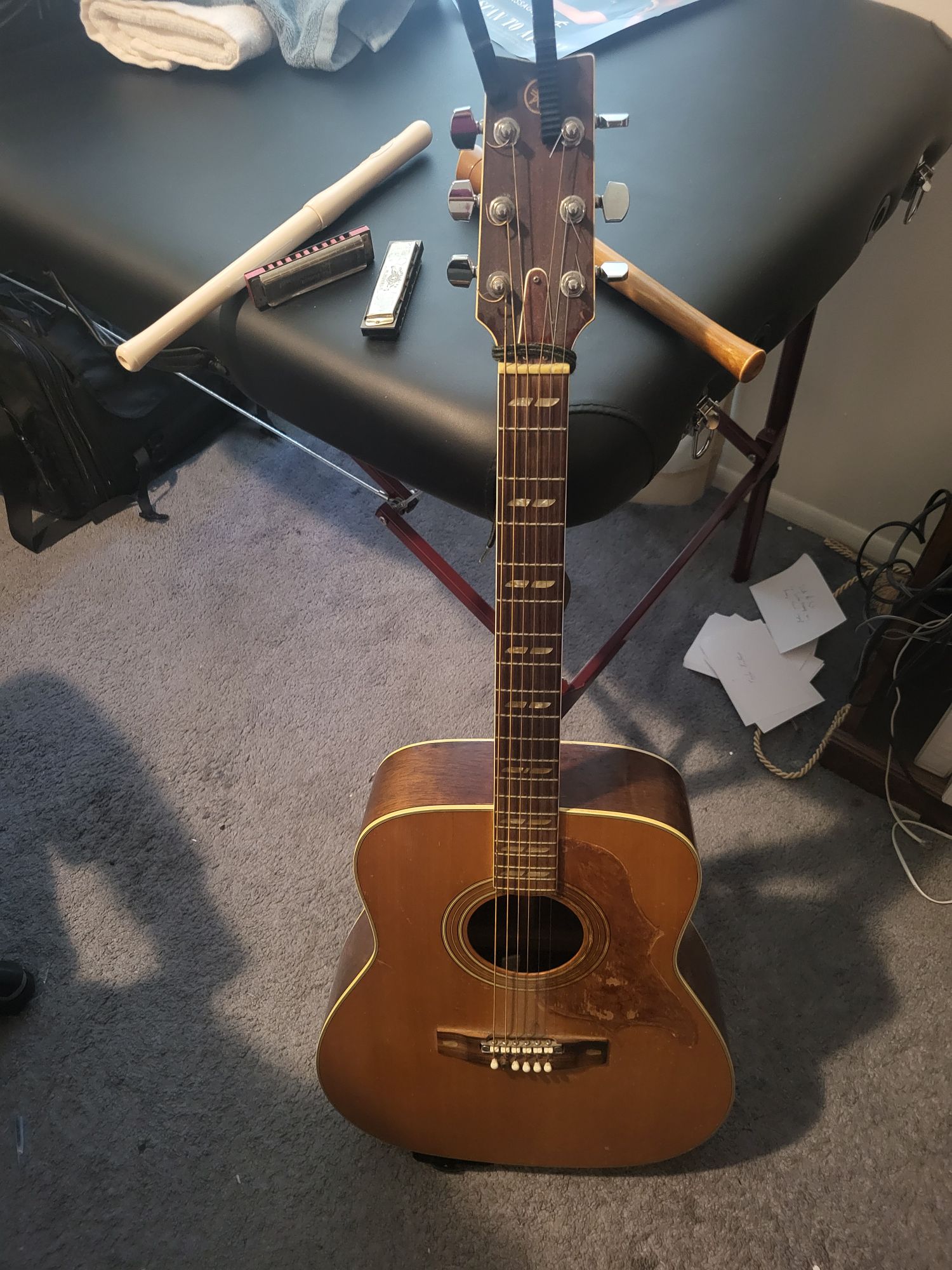
I learned about music in church. We didn’t use pianos and organs but we were all encouraged to sing.  I remember when I first recognized the different harmonies going on in our congregation. I would lean my head back and pick out the different parts. I heard my mom’s alto underneath the melody, and I especially enjoyed hearing the men sing bass.

When I got a little older, I learned to perform by joining the puppet ministry. I was this soft-spoken kid who became an outrageous ham when I hid behind the curtain and spoke with a puppet.

To sum up, I found music and my voice in church because I counted. 

I’m sorry I couldn’t stay.