The Boy Becomes a Preacher

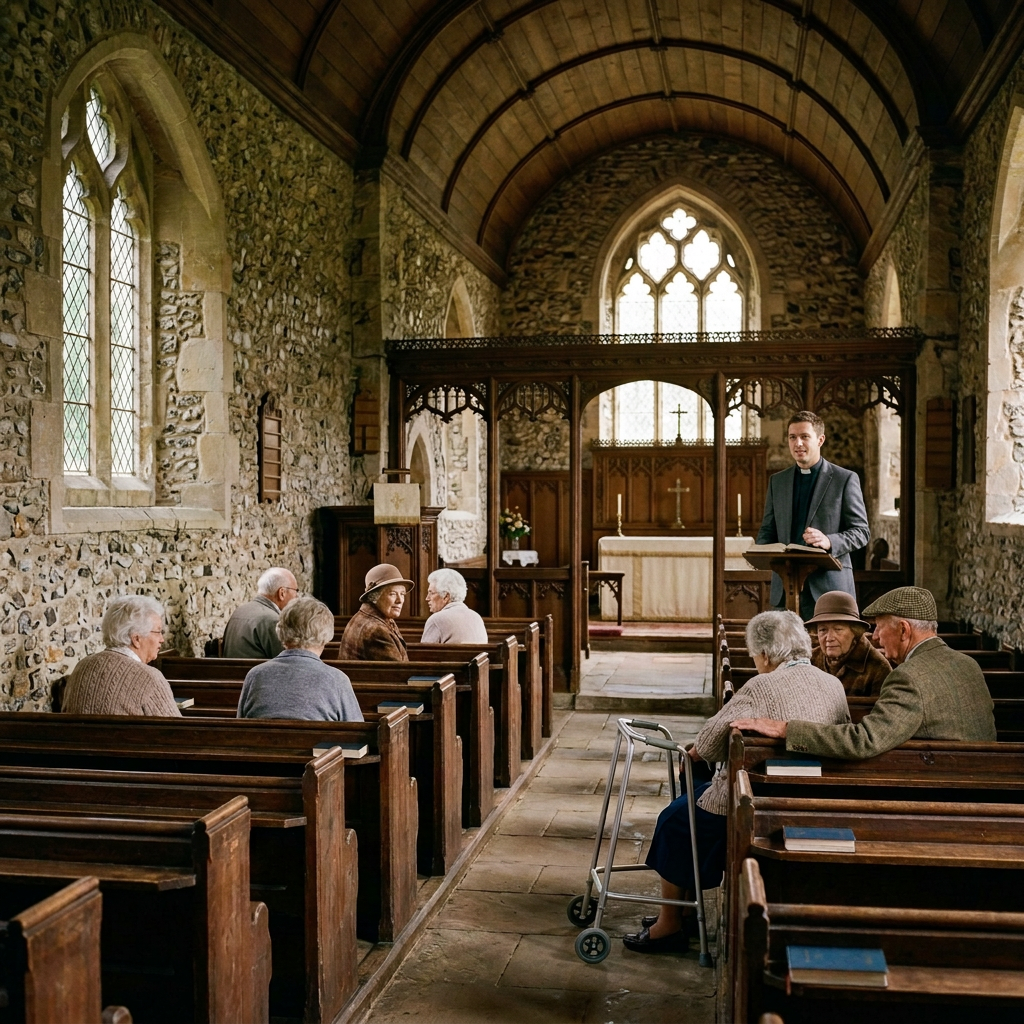
Four older adults walking through a churchyard beside a historic stone church

A 97-Year-Old’s Baptism

The Poor are Always with Us

Throwing Away the Script

“I need to get to church this Sunday,” my new friend said. “I’ve missed it lately and I need to get back. My whole week goes so much better when I go to church.” 

She’s a little older than me. Sweet… funny… kind.  As we chatted,  I nodded to show I was listening to her. 

Then she asked me: “Do you go to church?”

My head changed from going up and down to back and forth.

“Why not?” she asked, surprised

I gave a smile and a shrug.

She gave me her disapproving look. “You need to go,” she said.

I continued to smile and not answer.

“WHY don’t you go to church?” she said.

Not long ago, I would have told her I was an atheist, that I used to go to church, and in fact, I was a preacher, but now I have had enough of religion. Instead, I said gently.  “I don’t want to.” which prompted her to sputter.     

Bible Belters follow a script for moments like this but I was opting out of it.    

I could have said:

“I’ve been meaning to get back to church.”

She would have considered it an acceptable response but it ran the risk of prompting her to invite me to her church. Then I would have had to lie and say, “Thanks, I’ll try to make it sometime.” I’d never have any intention of doing so but she would feel better for having made an effort.   

But, like I said, I didn’t feel like following the script.

 “Didn’t you go when you were a kid?” she pressed.

“Yes. My dad was a preacher,” I volunteered.  “In fact, he still is.”

“He IS?” 

This time I gave a head nod. She went back to the script. 

“You should go back,” she said with a parental glare. I’m going to call your daddy and tell him that you’re not going.”

“You’re going to tell on me?” I laughed.  

She laughed too.  “Well I ought to,” she said. 

Then she went off the usual script, but it was still within the context of the show.

“I’m ashamed of you.” She said

“What?”

She repeated it and waited for my response. Most people aren’t so forthright. They let that part hang silently over the conversation like a dark cloud.

At this point, I suppose I could have taken the conversation in varying directions.  

Perhaps I could have shown a little remorse.

“You’re right,” I could have said. “I need to get my act together”.

Or I could have shown some outrage. “Who do you think you are?”

Or maybe I could have tried to explain myself.  “I’m sorry but I don’t believe anymore.”  But then I would have had to defend my not believing, and I’m tired of that.

I chose another direction and used my West Texas drawl.

“Oh now…, don’t talk that way…. You’re gonna hurt my feelings.”

I let her see my eyes twinkle.  She laughed and we went on to other topics

Why didn’t I get mad at her?

Because in the deepest part of herself, she didn’t mean it. She was trying to do what her religious leaders taught her to do and I could see that it caused her pain to say it.  But she thought she was supposed to.

She was the real victim, being forced to say things that weren’t part of her gentle nature. 

 I could have gone to my script and lectured her on the evils of religion, the superiority of science, and maybe thrown in some thoughts about the separation between church and state.

But… no.

A verse in her Bible says that a soft word turns away wrath (Proverbs 15:1). Maybe it can turn away religious aggression, too. In any case, she’s still my friend who knows that I have a different perspective. Perhaps when she’s ready we can have another conversation. 

I No Longer Reach for Heaven

In the churches of Christ, our religion was never really about heaven. Oh, we talked about it all the time, but really, it was unattainable. Instead, we lived under the self imposed threat of hell and condemnation.

We had a long list of things that snatched heaven away from our grasp: 

First, if you weren’t a true member of the Church of Christ, you couldn’t go to heaven. Baptists were condemned. So were the Methodists, Catholics, Pentecostals, and then all those other heathen religions on the other side of the world.

The Bible was the Word of God to be taken literally and if you didn’t believe in it the way we believed in it, you were going to hell. 

The only valid baptism was to be dunked completely in water and only then were you saved–until you had an impure thought, which is a sin as bad as murder, and made you condemned again.

Instrumental music in worship would send you to hell.

You couldn’t drink, dance, or let boys and girls swim together.

And no looking at women with lust in our hearts. That one pretty much sunk me. 

I knew I wasn’t going to make it to heaven although I kept trying year after year, along with my fellow church members, but it was pretty hopeless.  However, we each kept our doubts to ourselves because we were supposed to be positive that we were going to heaven, which added another layer of craziness to the mix. 

We went out into the world sharing this message of “Good News.” I’m astounded that anyone could be persuaded to accept a way of life that guarantees their condemnation.  But I’m sorry to say we made converts. It makes me think of Jesus words:

You shut the door of the kingdom of heaven in people’s faces. You yourselves do not enter, nor will you let those enter who are trying to…. You travel over land and sea to win a single convert, and when you have succeeded, you make them twice as much a child of hell as you are.

–Matthew 23:13-15 NIV

When I got to college, I stumbled into teachings that said although we were all sinners, Jesus’ sacrifice made it possible to be forgiven and allowed into heaven.  I remember the relief flooding through me when I realized I’d been let off the hook and was delivered from the fear of spending eternity in a place seven times hotter than the sun.

That was the message I preached to my churches.  I vowed to be a minister that made heaven available to everyone. I told the stories of Jesus touching lepers and saving prostitutes. I chose scriptures that emphasized the concepts of grace, forgiveness, and redemption.  Sometimes I was criticized for talking too much about grace and not enough about condemnation, which made me proud because I was proclaiming truth in the face of persecution–if people being snotty to me could be called persecution. 

It took an incredibly long time for me to see the flaw of a god circumventing his own wrath through a human sacrifice in order to offer his kindness to humanity.  Eventually, I decided hell just didn’t fit in a context of God loving everyone unconditionally.  Finally, I rejected the whole idea of deity and religion.  

I guess I’ve come full circle. I’m still not going to heaven but I’m no longer afraid.  

Truth, Lies, and Blue Skies

In a Peanuts cartoon, Linus is looking up in the sky thoughtfully as Lucy walks by.

“Lucy,” he asks earnestly, “Why is the sky blue?””

Lucy says emphatically, “BECAUSE IT ISN’T GREEN!!!” and then walks away.

Linus says, “That just shows how stupid I am. I thought there would have been a more complicated reason.” 

https://www.gocomics.com/peanuts/1958/08/14

I saw this kind of conversation occur regularly in the churches I knew. An innocent asks a question and is chided for doing so. 

The biggest grudge I have against religion (particularly conservative religion) is that it urges people to lie even as it touts its message as truth, usually called “The Truth.”  

Religion leads us to hide our real flaws even as we show off a false humility. We say to each other the things we think we’re supposed to say rather than what we really think. Preachers stand and speak things with a certainty that they couldn’t possibly have unless they are crazy. The most harmful dishonesty of all is how we force ourselves to believe in something because someone told us we were supposed to. And it’s downright wicked that religions use intimidation, accusation, and fear to control people and then call it love. 

When preachers meet, they often discuss how dysfunctional their congregations are, but it’s the unreality of religion that makes everyone dysfunctional. I think that’s why we see so much scandal in our churches.  Everything is a cover up, so of course some of what we hide is going to be quite scandalous. 

It’s ironic that the ideas of faith, spirituality, and infinity (or eternity) are limitless concepts meant to stir our imagination and inspire us to reach beyond the known to the realm of ideas, dreams, and questions, and yet these are the things that religion tries its damndest to stamp out.

I think religion will always be mortal enemies with science, which teaches to search for what actually is true. It’s also ironic that while science uses metrics, logic, and mathematics to examine, reexamine, ask questions. and adjust itself as needed, it also allows for imagination and dreams.

So is there a point to be made other than offering another reason why I think religion sucks?

How about this? This is for all the people in the churches I once preached to:

The search for truth begins and ends with questions rather than convictions. You know those questions that you’re afraid to even think about? Start with them.

I recommend an easy to read book by David Hayward, entitled, “Questions Are the Answers.”

A Friendship Begins

Craig was tall, bald, and quiet. He had been visiting our services for a few weeks when I approached him in the church foyer.

“I’m been so glad you’ve been coming to our church,” I said.  “Somebody just told me that you play the piano.”

He nodded.

A little shy, I thought.

“Would you want to play for us, sometime?” I asked.

“Um… I don’t know.  Not everybody likes how I play.” He said.

Ah, he lacked confidence.

“Well, we’re pretty easygoing around here,” I coaxed him. “If music is your gift, perhaps this is a safe place for you to express it.”

“Um… well maybe. I’ll think about it.”

I didn’t push him further. I didn’t want to scare him off.

However a couple of weeks later, when the regular pianist didn’t show up, I found Craig sitting in a pew a few moments before the service was to start.

“Craig, my pianist just called and said she can’t be here today. I know it’s a lot to ask but do you think you could step in for her?”

He sighed thoughtfully, then said, “Um… sure. I can do that.”

I was taking a risk. I mean, what if he was terrible? But I had a feeling he would be okay. And if he wasn’t, well… that’d be okay, too. 

I stood up to start the hymn. I raised my arm and then lowered my hand to give the downbeat. And that’s when Craig exploded all over the piano. 

He played a rock-em-sock-em, gospel, boogie woogie version of “Standing on the Promises” that our little group had never experienced before. At the end, he ran his fingers down the keyboard in a grand glissando, followed by a final wham on the base note.

The congregation was delighted and I was flabbergasted.  Who was this guy and where did he come from?  

It turns out that Craig was not only an extraordinary musician, but also a social worker, a child and adolescent counselor who saved lives, and an intellectual with many interests. I don’t know why he chose to come to my church but I’m glad he did because he went on to become my friend and mentor.

He shared many extraordinary things with me that I’ll be sharing here. 

A Conspiracy of Silence

My aunt was funny, brash, and loving. Athletic and adventurous in her younger days, tender and caring until the day she died, she was adored by everyone.

But she had a secret, sort of….

She was a lesbian.

Everyone knew but they never spoke of it. Perhaps it was best that way since everyone thought it was shameful and wicked. Silence saved us all from discomfort and embarrassment. It was easier.

Okay, maybe not easier, but silence at least made life safer because if she had been open about herself, she could have been in physical danger at times. More recently, I’ve wondered about the emotional and psychological pain she suffered as a consequence of her (and our) silence.

I was still a minister when I had my last face-to-face conversation with Mom before she died. It was early in the morning and we sat at the kitchen table while I told her that Christianity had been wrong to condemn the LGBTQ and I had been wrong in standing by silently. It was my intention, I told her, to begin a support group within my church where the LGBTQ in our community could come to talk and worship. However, while most of my congregation was on board, I still had to find a way to provide privacy for them because Oklahoma, like a lot of regions, is still not friendly to the LGBTQ*

Mom showed a great deal of interest, which surprised me. I thought she’d be uncomfortable, maybe even a little afraid for me. However, she asked me more about my thoughts regarding the scriptures and church doctrine. I told her that Jesus never made an issue of people’s sexuality, and he defended those who had been shamed by society. He said that people would be welcomed into heaven based on acts of love, not their religion.

She nodded and then she told me about her recently deceased sister.

Years before when they were much younger, they had attended a weeklong religious revival. On the last evening, the preacher gave the invitation and while the song played “Just As I Am,” he waited for people to come down the aisle to repent publically of their sins so they could gain forgiveness and redemption.

My aunt looked at Mom who nodded to her in encouragement. And then Mom’s sister went to the front of the church where she was baptized.

For a few moments, my aunt felt forgiven and clean. Her sins were washed away and she was now acceptable in the eyes of God. But redemption doesn’t last long in the church. My aunt remained a lesbian and she went on to have a relationship with her partner that lasted the rest of her life.

My aunt was one of the kindest people the world has known. She checked on the people around her, asking after their health and other concerns. People loved her and opened up to tell her all their problems. And she was generous, giving her time and energy to make people more comfortable. Mom said that she once watched her sister literally give away her last nickel.

“You tell me,” Mom blurted out to me that day in the kitchen, “that a woman like my sister didn’t make it to heaven!”

I assured her that she did.

I don’t believe in heaven or hell or God and Jesus anymore. They’re not real. However, the church and its conspiracy of silent condemnation are quite real.

I find myself shocked at what we did to my aunt and others like her. I’m horrified that we locked my sweet, loveable, funny aunt into a prison of silence, where she dreaded the day she would die and go to the hell we had created. And I think of my mom, who worried that she would never see her sister in heaven. And I think of the people in the LGBTQ who are offered only condemnation by their churches.

I deeply regret that I was a leader in that culture and that I stood by while the silent ones were alone in shame and fear.

I’m so sorry.

_ _ _ _ _ _ _ _ _

*I moved away from town soon after and never started that support group.

Drowning in the Baptismal Waters

She was eleven years old.

She had been at an evangelical church camp–a week full of morning Bible studies and evening assemblies with emotionally charged music, stories, and sermons. On the final night, the guest preacher spoke of their need to be forgiven of their sins to be saved from eternal hell and to beg for the gift of heaven.   

The girl walked up the aisle and said she wanted to be baptized.  The people applauded and shouted “Amen!” Her tears flowed freely and the preacher explained it was because the Holy Spirit had gotten hold of her.   

I was one of the spiritual guides at that camp and I was assigned to “counsel” her on the spot. While she sat in the pew, sobbing, I knelt in front of her so I could see her face. 

“Have you been baptized before?” I asked. 

“Yes, but I need to do it again,” she said.

“You don’t really have to,” I said. “You’re already saved.”  

“Yes, I do,” she insisted. “Because I’ve been so bad since then!” 

“Why don’t you wait till you go home and you can talk about it with your parents?” I suggested. 

“No! I have to do it now!”

I was afraid she was about to reach a new level of hysteria.  I said, “Okay, but first let’s call your parents on the phone. They’ll want to know.”

She nodded.

As I led her from the crowd, she said in a broken voice: “I’m so happy…”

After talking to her parents, she decided to wait until she got home where she could be baptized in her own church. I was relieved that we slowed things down so she could rest and be with her family first.   

“I’ve been so bad,” she said. 

At eleven years of age, what could she have done that was so bad? Did she sass her parents? Had she snuck out at night to be with her friends? Had she gone “all the way”?

Did these things make her evil? Did she deserve to burn in hell forever? That’s what we taught her.  In fact, there were many lesser things, including “bad thoughts,” that would send her to hell.  Her only escape was to have special words said over her and then dunked (again) underwater.

It was a long time ago and I’ve had darker questions since then.

What if she had been molested?  What if someone had told her it was her fault? It has taken me a long time to see that our religion could be a tool to prey on the vulnerable.  The baptismal waters come closer to drowning them rather than cleansing them.     

I’m ashamed that I was part of a system that says people are evil and deserve to burn eternally.

At the time, I thought of myself as a reformer who was changing the church from the inside in Jesus’ name. I did my best to shield people like this girl from abuse but I was merely helping adjust things enough to allow an unhealthy institution to continue functioning.

I wish I had never been a part of it. Yet I also wish I had helped her more while I was there.

“Honey,” I could have said, “I don’t care what you’ve done, there’s nothing evil about you. You are a wonderful person. You don’t need to be saved. If there is a god, I’m sure he likes you fine.”

In fact, I wish I had stood up and told all the kids the same thing and then said, “You’re all marvelous, just as you are, and you don’t have to listen to this crap.  In fact, we can all stand up, march out of this place, go home, and be happy.

“C’mon. I’ll go first.”   


They Can’t Forget Me If They Never Knew Me

So I got an invitation in the mail to attend the 35th reunion of my college—a private religious university where I got my undergrad degree in ministry.  The envelope was addressed to me and my former spouse. They got my new address right but not my new life. 

It’s interesting how much my old Alma Mater tries to maintain contact with me because when I attended, no one even saw me, much less knew my name. If I were to attend the reunion, I would remember a great number of my former classmates but they wouldn’t remember me.  

I guess I can’t really blame them. I didn’t speak much in the classes, or outside of them, for that matter. When I did I felt like I was intruding on their private conversations.  They often looked at me as if I was odd and perhaps stupid, and I came to see them the same way. I didn’t jockey for attention on campus in any of the prescribed ways.  I was too busy working and going to class to do any of their deadly dull activities. 

I’m sure all of my professors are dead now because they were old then. In fact, they had taught my father’s classes thirty years before. They were an odd, mostly sweet group of guys with their moldy suits and musty lesson plans, none of whom could remember me even when I attended. It may not have been their fault. I just couldn’t bring myself to sit on the front row like others did, panting like a puppy about to wet itself to show how excited I was to be there.  

I was never one of them and in hindsight I realize I never wanted to be. So, no, I don’t plan on going back to visit friends I never actually had.