Please Don’t Despise Poor People

She came to my office in tears and showed me a cut-off notice for her electricity. A lot of people passed through our small town and stopped at church to ask for help. We tried but we often had to turn people down because of our limitations. However, this woman was a local whom I often saw working at two different jobs: one at the convenience store, the other at the café. I also knew that she cleaned several houses in the community. 

But as hard as she worked, she couldn’t pay all her bills. She applied for food stamps and had been turned down. 

I arranged for the church pay her bill and then I went with her to the Department of Human Services to help her apply again for aid.

The ridiculous amount of paperwork was daunting, even to me, and I was a college graduate.  The forms were in English and while the woman spoke the language well enough, she didn’t read it well.  When we waded through it all and turned it in, the case manager glanced at it and immediately gave her some emergency food stamps, then arranged for her to get regular aid. 

I’ve been hearing from some of my friends that they are tired of their tax dollars being used to enable people who were too lazy to work.  But this lady wasn’t lazy in the least. She worked as hard as anyone I knew.

There are many working poor in this country, as well as unemployed people who aren’t lazy. 

These days, I’m a cashier at the grocery store and people often buy their food with funds from the state.  They have to shop carefully because the state will only buy certain brands and amounts.  If they pick up the wrong brand or size of package, it holds up the line until we can resolve the issues.  Many of them are young women with small children and English is not their first language.  They’re often tired, frustrated, and embarrassed.

I often share with them that if it hadn’t been for food stamps when I was a young father, my own children would have gone hungry, even though I often worked two jobs at the same time. I never have the time to tell them that my wife’s family had to have help when her father became ill and couldn’t work anymore. Plus, I have a friend who often tells how her family depended on government aid when she was a child—she grew up to be a teacher and a counselor. 

I’ve been hearing from friends who are expressing their outrage that they work very hard, making it on their own, and they don’t expect the government to bail them out. Why should they be expected to share with others?

First, they’re not sharing that much.  The percentage of our taxes that go to caring for the poor is quite low compared to the cost of military expense, Social Security, Medicare, and even administrative costs. 

Second, I want to point out to people who are able to pay their bills aren’t really doing it on their own. They often have deep rooted family and community support.  Plus, we all benefit from government funds through public education, police protection, as well as a vast infrastructure that provides highways, electricity, and communication. 

Finally, I want to ask specifically some of my longtime friends: What about your Christian values? Your Bible talks a lot about caring for the poor.  Do the words of Jesus mean something to you, or is it just Sunday morning chitchat? By the way, I can tell you that your churches aren’t getting the job done.

I know that life is hard even those who have enough money (for now). But I wish folks would speak of their frustrations with more precision and knowledge without insulting people. Those people have names and like you, they’re doing the best they can.

And if you want things to change, do your homework and get in touch with your elected officials, rather than quoting wildly inaccurate, as well as hurtful, things on Facebook. 

A Conspiracy of Silence

My aunt was funny, brash, and loving. Athletic and adventurous in her younger days, tender and caring until the day she died, she was adored by everyone.

But she had a secret, sort of….

She was a lesbian.

Everyone knew but they never spoke of it. Perhaps it was best that way since everyone thought it was shameful and wicked. Silence saved us all from discomfort and embarrassment. It was easier.

Okay, maybe not easier, but silence at least made life safer because if she had been open about herself, she could have been in physical danger at times. More recently, I’ve wondered about the emotional and psychological pain she suffered as a consequence of her (and our) silence.

I was still a minister when I had my last face-to-face conversation with Mom before she died. It was early in the morning and we sat at the kitchen table while I told her that Christianity had been wrong to condemn the LGBTQ and I had been wrong in standing by silently. It was my intention, I told her, to begin a support group within my church where the LGBTQ in our community could come to talk and worship. However, while most of my congregation was on board, I still had to find a way to provide privacy for them because Oklahoma, like a lot of regions, is still not friendly to the LGBTQ*

Mom showed a great deal of interest, which surprised me. I thought she’d be uncomfortable, maybe even a little afraid for me. However, she asked me more about my thoughts regarding the scriptures and church doctrine. I told her that Jesus never made an issue of people’s sexuality, and he defended those who had been shamed by society. He said that people would be welcomed into heaven based on acts of love, not their religion.

She nodded and then she told me about her recently deceased sister.

Years before when they were much younger, they had attended a weeklong religious revival. On the last evening, the preacher gave the invitation and while the song played “Just As I Am,” he waited for people to come down the aisle to repent publically of their sins so they could gain forgiveness and redemption.

My aunt looked at Mom who nodded to her in encouragement. And then Mom’s sister went to the front of the church where she was baptized.

For a few moments, my aunt felt forgiven and clean. Her sins were washed away and she was now acceptable in the eyes of God. But redemption doesn’t last long in the church. My aunt remained a lesbian and she went on to have a relationship with her partner that lasted the rest of her life.

My aunt was one of the kindest people the world has known. She checked on the people around her, asking after their health and other concerns. People loved her and opened up to tell her all their problems. And she was generous, giving her time and energy to make people more comfortable. Mom said that she once watched her sister literally give away her last nickel.

“You tell me,” Mom blurted out to me that day in the kitchen, “that a woman like my sister didn’t make it to heaven!”

I assured her that she did.

I don’t believe in heaven or hell or God and Jesus anymore. They’re not real. However, the church and its conspiracy of silent condemnation are quite real.

I find myself shocked at what we did to my aunt and others like her. I’m horrified that we locked my sweet, loveable, funny aunt into a prison of silence, where she dreaded the day she would die and go to the hell we had created. And I think of my mom, who worried that she would never see her sister in heaven. And I think of the people in the LGBTQ who are offered only condemnation by their churches.

I deeply regret that I was a leader in that culture and that I stood by while the silent ones were alone in shame and fear.

I’m so sorry.

_ _ _ _ _ _ _ _ _

*I moved away from town soon after and never started that support group.

Essential Work (101st Post)

I’m scared like everyone else right now. I have one of those essential jobs where I come out of isolation to sell groceries to people, some of whom could be contagious. The anxiety hangs on me like an extra weight that I carry wherever I go. Sometimes it gets me down but it’s my job and there’s nothing to do but stand back up, carry on, and take precautions as best I can.

I also feel an exhilaration similar to when I was a minister and provided help in times of crisis. These days, while I may be an anonymous cashier, I get the occasional chance to encourage strangers as they pay for their groceries. Somehow, the risk makes the work feel more meaningful.

Many folks go to the supermarket because they’re hungry not only for food but for company and so shopping is their social event for the day. I smile and joke with them about how our only recreation now is Netflix and fattening food. And we’ll laugh about not having any excuses to not clean house now. Then we’ll conclude our transactions and encourage each other to stay safe and healthy.

Some people are glum and focused inward. It’s a judgment call as to whether I should respect their privacy or go in to draw them out.

“It’s kind of scary out there, isn’t it?” I might say. Sometimes it’s enough to get them to share their stories:

“I never dreamed it would get this bad….”

“My mother is 78 years old with a heart condition….”

“I don’t know when I’ll go back to work again….”

“My child has asthma….”

I remember a man who murmured how afraid he was. I said I was too and then I searched for words that wouldn’t sound too preachy and would lend him courage. I said, “There’s nothing to do but hang in there, and that’s what you and I are going to do, huh?” He nodded and squared his shoulders as he walked out.

Another young man came through the line to purchase a cake and candles.

“Whose birthday is it?” I said.

“Mine,” he said shyly.

He was twenty-two that day. I asked if he had anyone who would celebrate with him and he shrugged saying he was by himself, unable to get home to his family who lived across an ocean from him. I thought about my sons who live far from me. I wanted to shake his hand, maybe pat his shoulder… oh hell, I wanted to give him a hug, but of course, we all have to keep our distance now.

So I gave a big smile and pointed at him, saying, “Happy birthday, my friend. I am very glad you were born twenty-two years ago.”

I cried when I told Sylvia about it later.

For me, being amidst the people, saying something that helps a little, and connecting for just a moment, gives me a boost and allows me to carry my own fear with a little more grace.

I like it even though it also brings back an old fatigue that always follows the exhilaration. I let it all go when I left the ministry but I always knew I’d somehow pick it up again, this time without the baggage of religion.

I’m going to work now. It’s essential.

Will God Answer for His Actions?

The following questions often lurk in the believer’s mind, especially at times like these when we are dealing with the COVID-19 virus.

Over my time as a minister, people whispered these questions to me, often ashamed to put them into words. I’m articulating them in hopes of engaging their thinking.
I’m not asking anyone to justify their theology to me. I don’t need to have answers to these questions anymore. However, I’m happy to have a discussion and I promise to reply back gently and genuinely. I’ll monitor the comments and omit any that are hostile or disrespectful.  


Why does God allow any disease to afflict us?

I used to deflect this one by saying God isn’t really doing this to us, but that in some way we’re doing it to ourselves. But if God is Lord of everything, doesn’t that make him responsible for everything including the COVID-19 virus?


Why does he indiscriminately hurt everyone?

Some say sickness is punishment for specific sins that some people are committing. For instance, it’s popular to blame the LGBT, saying we are all suffering for their sinful lifestyle. It’s an ugly accusation, and it makes no sense. Why wouldn’t God specifically target a group with whom he is angry?

Others say we’re being punished for the general sinfulness of the world, but that’s not really fair, either. Some are worse than others and some are more innocent.

I know–one sin is as bad as another in the Christian religion (James 2:10). But c’mon! We all know that isn’t so. Angry babies aren’t as guilty as bank robbers.


How does our suffering prove God’s love for us?

Some refer to Hebrews 12:6, saying that God isn’t out to hurt us but in fact is disciplining us because he loves us so much.

Really? Abusive parents say the same thing when they beat their children.


How does allowing us to suffer reveal God’s mercy?

Many say our suffering is a natural consequence of our actions. We bring it on ourselves and we have to get ourselves out of it. The babies have to suffer right along with the bank robbers because we brought it on ourselves collectively.

So… God won’t help us out with this because it’s our fault? Isn’t he supposed to be merciful? Isn’t he interested in “saving us from our sins?” When my kids were about to hurt themselves seriously, I intervened. The heavenly father doesn’t do that, too?


Is God just… mean?

Could it be that God doesn’t really love us? Is he playing with us for his amusement and then demanding us to believe he isn’t mean, but in fact is loving and kind.? Again, I refer back to the comparison of an abusive parent.


Is God limited in his power?

Maybe God does care for us but he’s not infinitely powerful, as he’s purported to be. After the creation, the plagues, and the resurrection, maybe he tapped out and now we’re on our own.

Anytime we get this far in the conversation, someone wants to say that God’s ways are not our ways and God’s thoughts are not our thoughts (Isaiah 55:8-9), meaning that we’re not smart enough to comprehend the ways of God.

You’re telling me that God, who supposedly had a whole Bible to reveal himself to us, whose son spent all that time teaching about the kingdom of heaven, has failed in the attempt to communicate? Isn’t he great enough to overcome our weaknesses?


Is it wrong to ask questions?

Now we’re at the point where someone says I should have faith in God’s power and good intentions. We shouldn’t allow ourselves to question God. Such questions create doubt. We should not “allow Satan a foothold….”

Really? No questions at all? We’re all sort of an interested party here when it comes to COVID-19. If he’s doing this to us or simply allowing this to happen when he could stop it, is it fair for him to get angry when we ask questions?

Let’s just concede that I’m being deliberately dense, that I can’t see the truth because I don’t want to see it, and I would be much better off if I accepted God’s will without question.

Is that working for you? Are you relieved of fear? Are you experiencing that peace that passes understanding?

If you say yes, I don’t believe you.

I spent thirty-five years trying to allay the fear and anxiety that people in my churches experienced. I tried to explain away the inconsistencies. I tried to help them feel better with the blessed assurance that Jesus was theirs. But it was a temporary fix, at best.


Final Questions:

Why spend time praying to a God who doesn’t answer back, who doesn’t explain himself, and who doesn’t intervene like He promises? Why sing to him and dedicate group praise to him? What exactly has he done to deserve any of our attention as a time when we need each other so much?

Drowning in the Baptismal Waters

She was eleven years old.

She had been at an evangelical church camp–a week full of morning Bible studies and evening assemblies with emotionally charged music, stories, and sermons. On the final night, the guest preacher spoke of their need to be forgiven of their sins to be saved from eternal hell and to beg for the gift of heaven.   

The girl walked up the aisle and said she wanted to be baptized.  The people applauded and shouted “Amen!” Her tears flowed freely and the preacher explained it was because the Holy Spirit had gotten hold of her.   

I was one of the spiritual guides at that camp and I was assigned to “counsel” her on the spot. While she sat in the pew, sobbing, I knelt in front of her so I could see her face. 

“Have you been baptized before?” I asked. 

“Yes, but I need to do it again,” she said.

“You don’t really have to,” I said. “You’re already saved.”  

“Yes, I do,” she insisted. “Because I’ve been so bad since then!” 

“Why don’t you wait till you go home and you can talk about it with your parents?” I suggested. 

“No! I have to do it now!”

I was afraid she was about to reach a new level of hysteria.  I said, “Okay, but first let’s call your parents on the phone. They’ll want to know.”

She nodded.

As I led her from the crowd, she said in a broken voice: “I’m so happy…”

After talking to her parents, she decided to wait until she got home where she could be baptized in her own church. I was relieved that we slowed things down so she could rest and be with her family first.   

“I’ve been so bad,” she said. 

At eleven years of age, what could she have done that was so bad? Did she sass her parents? Had she snuck out at night to be with her friends? Had she gone “all the way”?

Did these things make her evil? Did she deserve to burn in hell forever? That’s what we taught her.  In fact, there were many lesser things, including “bad thoughts,” that would send her to hell.  Her only escape was to have special words said over her and then dunked (again) underwater.

It was a long time ago and I’ve had darker questions since then.

What if she had been molested?  What if someone had told her it was her fault? It has taken me a long time to see that our religion could be a tool to prey on the vulnerable.  The baptismal waters come closer to drowning them rather than cleansing them.     

I’m ashamed that I was part of a system that says people are evil and deserve to burn eternally.

At the time, I thought of myself as a reformer who was changing the church from the inside in Jesus’ name. I did my best to shield people like this girl from abuse but I was merely helping adjust things enough to allow an unhealthy institution to continue functioning.

I wish I had never been a part of it. Yet I also wish I had helped her more while I was there.

“Honey,” I could have said, “I don’t care what you’ve done, there’s nothing evil about you. You are a wonderful person. You don’t need to be saved. If there is a god, I’m sure he likes you fine.”

In fact, I wish I had stood up and told all the kids the same thing and then said, “You’re all marvelous, just as you are, and you don’t have to listen to this crap.  In fact, we can all stand up, march out of this place, go home, and be happy.

“C’mon. I’ll go first.”   


They Can’t Forget Me If They Never Knew Me

So I got an invitation in the mail to attend the 35th reunion of my college—a private religious university where I got my undergrad degree in ministry.  The envelope was addressed to me and my former spouse. They got my new address right but not my new life. 

It’s interesting how much my old Alma Mater tries to maintain contact with me because when I attended, no one even saw me, much less knew my name. If I were to attend the reunion, I would remember a great number of my former classmates but they wouldn’t remember me.  

I guess I can’t really blame them. I didn’t speak much in the classes, or outside of them, for that matter. When I did I felt like I was intruding on their private conversations.  They often looked at me as if I was odd and perhaps stupid, and I came to see them the same way. I didn’t jockey for attention on campus in any of the prescribed ways.  I was too busy working and going to class to do any of their deadly dull activities. 

I’m sure all of my professors are dead now because they were old then. In fact, they had taught my father’s classes thirty years before. They were an odd, mostly sweet group of guys with their moldy suits and musty lesson plans, none of whom could remember me even when I attended. It may not have been their fault. I just couldn’t bring myself to sit on the front row like others did, panting like a puppy about to wet itself to show how excited I was to be there.  

I was never one of them and in hindsight I realize I never wanted to be. So, no, I don’t plan on going back to visit friends I never actually had.  

Making Change at the Deli

“I’m not doing well at all!” the woman said angrily when my workmate asked how she was doing.  She continued to expound on her unhappiness while we sliced her cheese and ham at the deli. 

“See this face?” she said, “You may not be able to tell it but I am hurt and angry! I’m married to an awful man. He treats me rotten and I need to get away from him.

My colleague did not know what to say as the woman continued to talk with increasing volume, drawing the attention of other customers around her. 

She turned to yell at a man next to her who replied, “Lady, I don’t even know you.” 

“I don’t know you either,” she hollered as he skulked away.

 “Ma’am,” I interjected, “I’m so sorry it’s a rough day. I hope you have better days soon.”

“Really?” she said. I nodded, pleased with myself but only for an instant.  

“I’ll have better days when I divorce that man and I’m rid of him!”

And then she got even louder. 

“And don’t be wishing better days for him if he comes here! He doesn’t deserve it! You watch for him and you’ll see…. He’s a little Puerto Rican man with a goatee and he usually wears a blue shirt!”

“Right. Sure.”

She kept talking while she walked away. I looked at another customer and shrugged. “I thought I could help,” I said. 

You can’t win them all.

Even after all this time, I still have to remind myself that I never had mystical powers of healing, although people tried a little harder to pull themselves together and straighten up when they knew I was a minister. 

On the other hand, maybe the netting that covered my head and my beard concealed the holy benevolence of a former minister.  

Whatever.  In any case, I didn’t have that working for me anymore. Yet I truly thought my acknowledging her angst would help her feel calmer. 

But nope, it didn’t.

Wait… the story continues.

The next day she appeared again, this time peaceful and quiet.  When I asked how she was, she answered, “I’m doing much better,”

Only then did I recognize her.   

She was calm. Perhaps relieved.  Maybe she had gotten some sleep with the aid of modern medicine.

I remember you,” I smiled. “I was wondering how you were doing. I’m so glad you’re feeling better.”  I handed over her small purchase and she smiled when I repeated what I said the day before: “I hope you have better days soon.” 

And she left.  Quietly

Did she come back just to show she was better? Did she wonder if she would be welcome? 

It was suggested to me that perhaps she is bipolar and that makes sense. The first day she was enraged, the next day she was calm and peaceful. Her change had nothing to do with me. 

On the other hand, I was a guy who spoke kindly when she was in a bad way and that’s not nothing.

What I Said Then; What I Say Now

I was at a retirement home, giving my thoughts on a passage of scripture.  They knew I had once been a minister and that I now no longer believed. 

A woman asked me, “What would you say if your child asked you, “Did Jesus really walk on water? Did he really feed five thousand people? Would you tell them that it really happened just as it exactly as it says in the Bible? 

I took a moment to gather my thoughts.

“When my children were little,” I said,  “I did tell them that I thought it happened just as it said in the bible because back then I did believe. However, I would answer differently today.  I’d say something like… ‘Many good people believe these things really happened. However, it doesn’t seem likely that these things could occur. So, no, I don’t believe they did.’”

She nodded… accepting my answer, which was good because it was the only one I had.

A year or so before I left Christianity and was still wrestling with my beliefs, I taught a confirmation class for the young teens in my church. I reviewed church teachings with them and I talked about heaven, forgiveness, and the salvation through Jesus Christ.

I can still say what I said then:

“Your parents baptized you when you were little and raised you to hear the teachings of the church. But confirmation is your chance to take ownership of your thoughts and beliefs.  Nobody can make you. Not your parents. Not me. Even God won’t.” 

They all chose to go ahead with the ceremony because, in truth, they were still too young to decide for themselves. Evaluation of family beliefs usually happens during the college years when they are being trained to think critically for themselves. That’s when they start deciding for themselves what they believe.

I have always shied away from telling people what they HAVE to believe.  I still do.

On the other hand, I’m more than happy to say what I think is true, and I will argue strenuously with grownups who know (or should know) how to think for themselves. 

Friendly Opposition

My friend, Reverent D, is trying to pick a fight with me. Sort of  

He and I worked with each other a lot when I was in the ministry. He is quite conservative while I was quite liberal and we had many discussions where neither of us changed the other’s thoughts, but perhaps honed them a bit.  Iron sharpening iron.

We’ve made each other pretty mad at times but we remained friends. In spite of our different perspectives, we meshed well when it came to actual ministry because we are both professional caregivers. 

If someone is hungry, sad, lonely, tired, sick, or battered, he’s going to help because while he has doctrinal views with which I don’t agree, his first value is “love thy neighbor.”  So he’s the real deal when it comes to ministry.   It doesn’t matter if he agrees with me, he’s going to help because that’s who he is and that’s what he does.    

The year before I left God and church, he noticed I was in a bad way and inquired about my welfare often. He didn’t press when I evaded his questions but he didn’t quit noticing. After I left, and “came out” as an atheist, he has continued to maintain contact with me.  He continues to monitor my blog and checks on me occasionally.

typing crickets chirping

Recently, I wrote a few entries on Facebook about writer’s block where I spent hours facing a blank screen. With his mildly annoying humor, he decided to help (heckle) me.  He sent me a lame-ass video by Ray Comfort that supposedly proves God’s existence.  I’d seen it before. It’s the same hackneyed arguments that have been around for hundreds of years but it was just slick enough to get me riled up. 

Sure enough, my fingers started flying over the keyboard, attacking sacred ignorance wherever it may lurk.   I churned out one blog entry and I’ve got another in the works. 

typing 2

Which is what my friend, Reverend D, wanted. 

He enjoys the fact that getting me all agitated is actually helping me function even if he doesn’t agree with me.  He probably has some long term goal of getting me back into “the fold” and he knows that I know that.  No doubt he’s laughing about it. 

I wish to remind him that chortling isn’t dignified when it’s coming from the clergy. 

That gives me another idea for the blog entry…. 

The Clothes I Wear

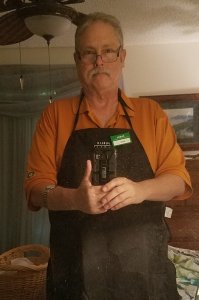
In the past few years, I’ve gone from preacher to teacher to deli worker.  I know it shouldn’t matter but I was embarrassed by how different I look in the mirror these days.  

I went from this: 

14663451005693996479136022471941.jpg
Preacher, Professor, Teacher (taken in my bathroom)

To this: 

20190628_164953-16848913001265796466.jpg
Deli Clerk

Do I think I’m better than the people with whom I work now? No, I do not.  And after I spent several exhausting hours my first evening at this new job, I was humbled because this deli gig is overwhelming.  My new workmates showed a great deal of patience as they trained me. 

I was also fascinated with them.  The shift supervisor is former military.  Another fellow had been a food service professional for many years.  Yet another had been a personal chef for one of the uber-rich families of Florida. And another is a music teacher at one of the elementary schools.  He does this work for extra income. Oh, and he also performs in a band. Finally, there is the woman who is raising her grandchildren while working fulltime.

They’re smart and old enough to have wounds that make them interesting, and I enjoyed exchanging life stories with them. 

They make the uniform look good.  I went from being embarrassed to hoping I’ll be worthy of it.