Remembering the Melodies

Photo by Pixabay on Pexels.com

Royal Shoelaces

A woman and her two little girls were going through the self-checkout.  While mom was busy, I talked to the girls.  How old were they…? Were they doing fun things on their vacation…?

“Your shoelaces are untied,” I said to the younger one. “I’ll tie them for you if it’s okay with your mom.”

She didn’t look up from her groceries as she said, “That would be fine. Would you like him to tie your shoes for you?”

She nodded.

I got down on my knees and carefully tied them.

“Is that okay?” I asked. “They’re not too tight, are they?”

It was okay. 

I noticed the slightly older sister had come closer and that her shoes were now also untied.

“Do I need to tie your shoes, too?” I asked. 

She nodded shyly. And so I did, asking the same questions to make sure I got it right. 

We were all pleased with this moment.  They liked that an old guy was taking care of a task they were still trying to learn.  I figured the mom was happy to let someone help out–I’m sure she had done this task often enough to where the entertainment value had faded.  But I hadn’t tied a little kid’s shoes in a long time, and I enjoyed doing it. 

If you think about it, we adults kneel in front of our kids a lot: when we tell them something important, or they need to tell us something important, or when they’ve hurt themselves, or when we play with them, or tuck them in at night.

Kneeling before the children reminded me of the words, “Of such are made the kingdom of heaven.”  And “…their angels to behold the face of God.” Sweet phrases that attempt to describe the value of children, as if they are the true royalty of our culture.

If we kneel to honor kings and queens, surely it is also appropriate to kneel before children as we attend to their needs. 

“Say thank you to the nice man,” their mother said as they left.

They did.  And I thanked them as well. 

The Best Way to Handle a Child’s Fit

When young families first arrive in town for vacation, they come directly from the airport to the store to get groceries for the next week. After a long day of travel, the kids are exhausted and prone to fits, and so are the parents.  I often hear the tired cries of babies erupting throughout the store. I sympathize because I’ve had my times of being tired and cranky too, and so I try to stay courteous as I get the families through the line quickly.  

Some of those fit-throwers stand out in my memory because of the way the adults handled the situation.

Photo by Mitya Zotov on Pexels.com

I remember one particular child who was pitching a lulu—screaming, grabbing things off the rack, colliding with other people.  The tired mom tried several techniques as she unloaded her groceries onto the conveyer belt: an angry glare, threats of no candy, no pool time, and no Mickey.  Finally, she gave up and tried to ignore him as she paid for her purchase. 

An old guy stood behind the boy and watched quietly.  He was tall, with a weathered face and a working man’s hands.  Before placing his groceries onto the conveyer belt, he took the little bar that divides the customers’ groceries and slammed it down, startling the boy into silence.  He looked up, and the old guy loomed over him, offering a friendly gaze.  The child remained quiet and wide-eyed while the mom gathered her groceries, took the boy’s hand, and left. As she exited, she glanced over her shoulder to give the man a grateful look.

I also sympathized with the way another mom handled her obnoxious kid. He was a plump fellow and too old to be riding in the grocery cart—he took up most of the room intended for purchases. With his big boy lungs, he kept yelling at his parents to let him buy something. 

“Give me five dollars, give me five dollars, give me five dollars, GIVE ME FIVE DOLLARS!

The parents did their best to ignore him until the mother had enough. She whirled from the self-checkout screen and shimmered with intensity as she said:

“Say that one more time.”

The message was received. The boy crossed his arms, frowned, snorted, and sputtered, but remained wordless. Evidently, he wasn’t as dumb as he looked.   

My favorite kid moment was between a father and his small child.  The kid was beyond exhausted, crying and screaming. The dad looked tired, but he stayed calm and spoke soothingly to his boy.

“I’m going to count to three,” he said. 

I thought he would use that technique that never works where you raise the threat level with each number. But instead, he used it as a relaxation technique to help his child get calm. 

“One,” he said softly, “Everything is ok.”

“Two, you’re feeling better.”

“Three, you’re getting quieter.”

It didn’t work, so he tried it again. And then again. Not once did the dad raise his voice to the screaming child. 

It would be a great story if I told you that the kid got calm and quiet, but he didn’t, at least not in the store. He was just too overextended. The dad picked him up gently and smiled at me as he left his purchases and walked out the door.

I admire how restrained the father was.  

The next day, they were back.  This time the boy looked rested and calm. I said, “I remember you. How do you feel today?” He smiled shyly. 

“He was very tired last night, wasn’t he?” I said to the father, who sighed and nodded with a bemused look. I think maybe he was still tired from the night before.

“I think you’re the best father in the world,” I said. “I wish I had been more like you while raising my kids.”

In fact, I wish all parents could be as gentle with their kids as this dad was.

A Child’s Power

The tired parents were struggling to work the machine at the self-checkout and had tuned out their toddler who was sitting in the grocery cart. He was bursting to help them work the machine. He stood up in his precarious perch so he could see better and he hollered at them to let him help.  Then he leaned and stretched to try to touch the machine but he was too far away, and he started to teeter. I was sure he was going to fall to the floor. 

I stepped over, reached out, and held the little boy, helping him gain his footing.  His parents turned and saw what nearly happened. And like tired parents do, they scolded him, while he ignored them.  He was still trying to get at the self-checkout machine. 

It has been a long time since I’ve held a child. In that brief contact, I felt that little boy’s energy and a wave flooded over me of memories where I held my own children when they were small. I’d forgotten how powerful the vitality of a small child can be.

Photo by Bess Hamiti on Pexels.com

What do I want to say here…?

I want to say that I miss holding my children.

Sometimes I missed seeing who they really were.

I also want to say that the story of a child born in utter poverty, who grows up to be the savior of humanity still resonates with me even though I’m an atheist.

Somebody’s children will one day find the cure for cancer. And somebody’s children will be significant ambassadors for peace.  And somebody’s children will be teachers, artists, scientists, and healers. And some will be almost anonymous workers who make life possible for their communities.

I think all children have the potential for greatness that can change the world. Sometimes I can almost see that greatness sparkling just beneath the surface of a child. 

I held one of those children briefly at the self checkout.

Nobility Over Veneer

A precocious young lady, around five years of age, strode to the self checkout machine, lugging two boxes of chocolate, sugar coated cereal.  I looked about for a parent but saw none.

“How are you today?” I enquired.

“Just fine,” she said primly. “How are you?”  

“Fine, thank you. Are you going to buy those?” I asked.

“Oh yes,” she replied as she continued her march to the machine

“Do you know how to use the self checkout?”

“Of course,” she said brightly.

Many adults can’t but this child seemed so confident, I wouldn’t have been surprised if she really could. However, I thought I should slow her down a bit.

“Did you bring your money with you?”

“Umm,” she paused, and then said, “You know… I’m pretty sure I left my money at home.”

“Perhaps we should wait until the person who brought you can help you can pay…”

She was not to be dissuaded but then a woman of grandparently visage entered the scene. 

“What are you doing here and where did you get that cereal!?” she demanded.

The young lady transformed into a whiny baby in an instant, complete with tears and angst.    

“Aaaaahhhh, But I wanna buy this MYSELF!”

“We’re not ready to pay yet,” tired grandma said, “And we’re not buying that stuff anyway.”

“But a WAAANT it!” yelled the once prim lady

I walked away to let them work it out for themselves and I could hear the threatening cadence of the grandmother’s voice–something about taking her straight home without stopping for ice cream while the girl continued to protest vigorously. 

Later, I encountered another young girl, again around five years old. This time I was manning the more conventional register when she came through the line with her parents.  She carried a pink toy scepter that lit up on the end.  Anyone could see it was special and understand why she clutched it so tightly. 

“So… are you really a princess?” I asked. 

She ignored my question, and earnestly explained, “I did not get this from the store. I brought it in with me. I’m not trying to steal it or anything.”

I nodded and told her I understood, but she went on to say again: “It’s already mine. I’m not taking it.”    

“I understand. Thank you for telling me.”

She told me one more time that she wasn’t stealing it.  Again, I nodded.

Her parents smiled as they rolled their eyes… I think they’d seen her caution and precision before.  I told them that their child was quite impressive.

Actually, both children had their charms.  I’ve no judgment against the first little girl, other than I found her entertaining.  But just like adults I’ve known, one of them only looked mature while the other one really was mature.

I would be very happy to find out the second child actually is a princess because it’s clear she already has nobility within her. 

Wouldn’t it be great if we had more adults who were that conscientious, precise, and communicative, rather than using a shiny veneer to hide their being selfish and whiny?

I’m sure these two children will grow up to be lovely versions of themselves.  I hope we adults can grow up to do the same.

Powerful Moments at the Checkout Counter

It was a busy evening during spring break and we were overwhelmed with customers. I’d been moving as fast as I could through my shift and I was tired during the last hour.  I was bagging up the items for a mom and her young daughter when I heard the mother whisper something to her child. The little girl came around the counter and spoke to me:

“Mr. David, thank you for taking care of us.”

“Why… thank you, darlin’.” I pulled my mind from the fatigue to focus on her. “You’re very welcome. You just gave me the nicest moment of my evening.”

They waved goodbye.

It’s fairly well documented that I’m an emotional guy so it won’t surprise anyone that I my eyes filled up and my throat had a lump that wouldn’t let me talk to the next three customers. 

It seems to me that the most significant moments with children happen when life is very busy. I missed a lot of them with my own kids when they were young. As an older guy, I know to watch for those moments but I can still overlook them. 

One time, a boy, about 8 years old, struck up a conversation with me while I was trying to fix the self-checkout register.  

“We are from South Carolina,” he said seriously.

“You are?” I said while I pushed various buttons on the uncooperative machine.

“Yes,” he said. “We’re staying at a hotel that has a pool.”

“Sounds pretty fun,” I said, although I was only half hearing him, and for some reason I was a little agitated with his slow speech while I was working furiously.

“We went to Universal today.”

“Uh huh. Did you like it?”

“Yes, we saw the Harry Potter exhibit.”

“That’s great,” I said as I resisted the urge to kick the machine..

“It was.”

Pause. 

“Have you seen it?” He asked.

“What? The Harry Potter exhibit? No, I haven’t.”

“Well… I won’t tell you about it. I don’t want to ruin it for you.”

I stopped. What an odd thing for a kid to say.  I took a moment to really look at him. He was chunky with red hair, freckles and a solemn face.  I glanced up and saw his dad, who was shaking his head, looking like he might be a little embarrassed. 

“Okay, thanks,” I said. “I hope the rest of your vacation is great, too. Have a nice day.”  

And then he was gone.  I thought about him later that night when I got home and I realized that the chunky boy with the contemplative nature was me, right down to his freckles.

I wonder now… is he as lonely as I was at that age, with no one to talk to, where kids his own age laughed at him for the strange things he said? Was he hoping to have a scrap of a conversation with an adult, even a busy grocery clerk, who might take him seriously?  

The most significant moments happen like this. When we’re busy and agitated, a quiet kid offers a piece of his heart to a stranger, and we nearly miss it.  As I think about him, I vow again, like I’ve done a thousand times, to step away from annoying little tasks and instead pay attention to the quiet children with big feelings.

However, when I pay attention to the children, it can be hard to keep working. 

Not long ago, a baby boy played peekaboo with me at the register.  He was a delightful kid and he made me smile until I thought about how my two kids had been cute like that and how I miss them now. They’re grown but it seems like yesterday I was playing peekaboo with them.  And then I started crying right there at the checkout counter. I struggled to pull it together enough to get to the end of my shift.

Before I went home, I sat for a moment at the table in the break room to get control of my feelings.  My coworker, JoJo, breezed through, said hello, then stopped. 

“You okay?” she asked.

I told her about the boy and admitted I was having a hard moment. I think she had seen me playing with the boy. Now I was crossing my arms and clenching my jaw, trying to hold myself together.  She approached me from behind to give me a spontaneous hug, saying she was willing to listen if I wanted to talk.  I didn’t and that was okay with her, too. She went on to work while I went home.    

The best moments happen quickly when you’re not quite ready. Little girls bless us with gracious words, little boys show the depths of their hearts, and babies make grown men cry. And when you can’t hold yourself together, a friend helps you out by putting her arms around you.    

Please Don’t Despise Poor People

She came to my office in tears and showed me a cut-off notice for her electricity. A lot of people passed through our small town and stopped at church to ask for help. We tried but we often had to turn people down because of our limitations. However, this woman was a local whom I often saw working at two different jobs: one at the convenience store, the other at the café. I also knew that she cleaned several houses in the community. 

But as hard as she worked, she couldn’t pay all her bills. She applied for food stamps and had been turned down. 

I arranged for the church pay her bill and then I went with her to the Department of Human Services to help her apply again for aid.

The ridiculous amount of paperwork was daunting, even to me, and I was a college graduate.  The forms were in English and while the woman spoke the language well enough, she didn’t read it well.  When we waded through it all and turned it in, the case manager glanced at it and immediately gave her some emergency food stamps, then arranged for her to get regular aid. 

I’ve been hearing from some of my friends that they are tired of their tax dollars being used to enable people who were too lazy to work.  But this lady wasn’t lazy in the least. She worked as hard as anyone I knew.

There are many working poor in this country, as well as unemployed people who aren’t lazy. 

These days, I’m a cashier at the grocery store and people often buy their food with funds from the state.  They have to shop carefully because the state will only buy certain brands and amounts.  If they pick up the wrong brand or size of package, it holds up the line until we can resolve the issues.  Many of them are young women with small children and English is not their first language.  They’re often tired, frustrated, and embarrassed.

I often share with them that if it hadn’t been for food stamps when I was a young father, my own children would have gone hungry, even though I often worked two jobs at the same time. I never have the time to tell them that my wife’s family had to have help when her father became ill and couldn’t work anymore. Plus, I have a friend who often tells how her family depended on government aid when she was a child—she grew up to be a teacher and a counselor. 

I’ve been hearing from friends who are expressing their outrage that they work very hard, making it on their own, and they don’t expect the government to bail them out. Why should they be expected to share with others?

First, they’re not sharing that much.  The percentage of our taxes that go to caring for the poor is quite low compared to the cost of military expense, Social Security, Medicare, and even administrative costs. 

Second, I want to point out to people who are able to pay their bills aren’t really doing it on their own. They often have deep rooted family and community support.  Plus, we all benefit from government funds through public education, police protection, as well as a vast infrastructure that provides highways, electricity, and communication. 

Finally, I want to ask specifically some of my longtime friends: What about your Christian values? Your Bible talks a lot about caring for the poor.  Do the words of Jesus mean something to you, or is it just Sunday morning chitchat? By the way, I can tell you that your churches aren’t getting the job done.

I know that life is hard even those who have enough money (for now). But I wish folks would speak of their frustrations with more precision and knowledge without insulting people. Those people have names and like you, they’re doing the best they can.

And if you want things to change, do your homework and get in touch with your elected officials, rather than quoting wildly inaccurate, as well as hurtful, things on Facebook. 

A Pin, a Bracelet…, and Community

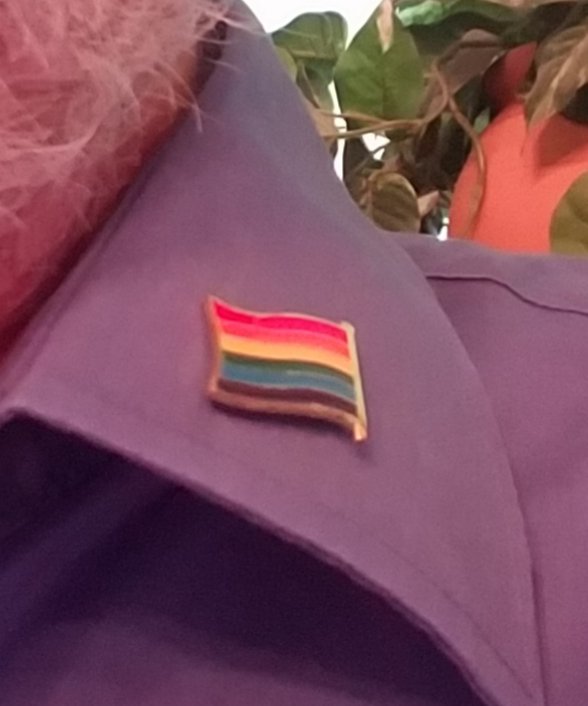
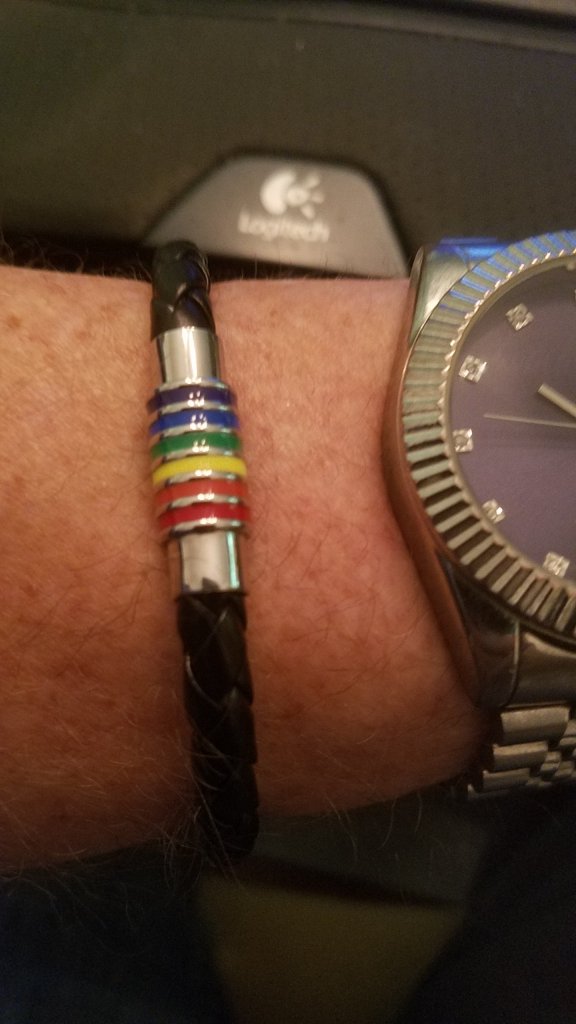
I wear a lapel pin of the LGBTQ flag and a bracelet with rainbow colors. I rarely go without them because it’s my way of showing support to people I love.

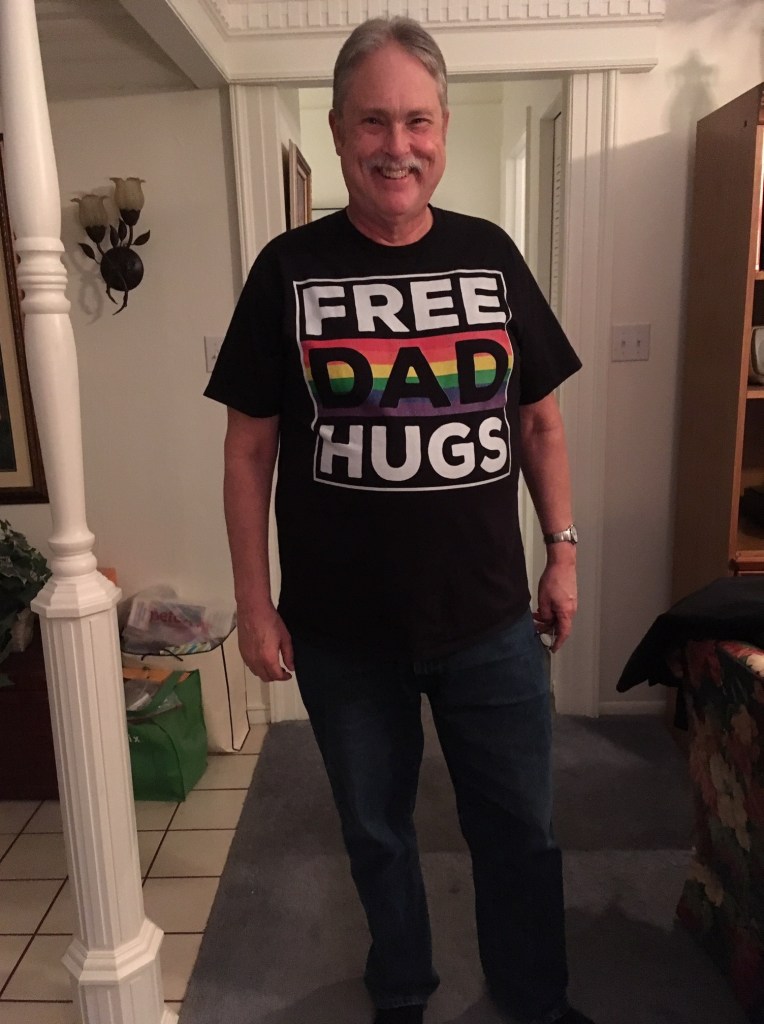
A lesbian couple comes into the store regularly to shop for and deliver groceries to homes.  I commented on the Pride shirts they wore and showed them my pin and bracelet. They said I needed a shirt and I told them about the one I wear that says “Free Dad Hugs.” It made them smile and they told me I “rocked.” (I’m pretty sure that’s a good thing.) I look for them every day and wave when I see them.  

Recently, I worked at a different store and my first customer noticed the lapel pin. She spoke very little English and it took me some time to understand that she liked it. I had the feeling that we were addressing each other as parents as we smiled and wished each other well.

Later in the evening a young man came through the line and admired the pin and bracelet. He said, “Last month was Pride Month, you know.” I told him I had been aware of it. 

His eyes were a haunted mix of fatigue and defiance, as well as a touch of joy, I think.

“I’m proud of who I am,” he told me.

I said, “If it’s worth anything, I’m proud of you, too.

Then just last night, a beautiful teenage girl who bagged the groceries at my counter told me how much she appreciated my pin and my bracelet. “I haven’t told my parents yet,” she confided. She shared more with me, enough for me to realize she was probably right to wait.

She came up to me later and said, “I’ve gotten to do a lot of different tasks tonight… not just bagging. It makes me feel like I’m part of something bigger.”

Wearing the pin and the bracelet makes me feel that way too. I wonder if she and I were actually feeling the same thing: part a much bigger community.

What I Said Then; What I Say Now

I was at a retirement home, giving my thoughts on a passage of scripture.  They knew I had once been a minister and that I now no longer believed. 

A woman asked me, “What would you say if your child asked you, “Did Jesus really walk on water? Did he really feed five thousand people? Would you tell them that it really happened just as it exactly as it says in the Bible? 

I took a moment to gather my thoughts.

“When my children were little,” I said,  “I did tell them that I thought it happened just as it said in the bible because back then I did believe. However, I would answer differently today.  I’d say something like… ‘Many good people believe these things really happened. However, it doesn’t seem likely that these things could occur. So, no, I don’t believe they did.’”

She nodded… accepting my answer, which was good because it was the only one I had.

A year or so before I left Christianity and was still wrestling with my beliefs, I taught a confirmation class for the young teens in my church. I reviewed church teachings with them and I talked about heaven, forgiveness, and the salvation through Jesus Christ.

I can still say what I said then:

“Your parents baptized you when you were little and raised you to hear the teachings of the church. But confirmation is your chance to take ownership of your thoughts and beliefs.  Nobody can make you. Not your parents. Not me. Even God won’t.” 

They all chose to go ahead with the ceremony because, in truth, they were still too young to decide for themselves. Evaluation of family beliefs usually happens during the college years when they are being trained to think critically for themselves. That’s when they start deciding for themselves what they believe.

I have always shied away from telling people what they HAVE to believe.  I still do.

On the other hand, I’m more than happy to say what I think is true, and I will argue strenuously with grownups who know (or should know) how to think for themselves. 

The Church that Wants to Kill People

This weekend, the Revival Baptist Church of Clermont, a town west of Orlando, has been hosting a conference called “Make America Straight Again,” They have invited speakers from all over the nation to come to speak of how evil the LGBT is. They had some video available but Youtube took it down, calling it hate speech.

They say about 300 people have attended, including small children.

Three years ago, fifty people were killed in Orlando’s Pulse Nightclub, a spot where the LGBT met.  Some of the speakers at this conference have said in the past that they thought the shooting was a good thing, and that the people deserved to die. However, one speaker said that they weren’t actually suggesting that someone should go around shooting gay people, but rather the government should officially execute them.

Many conservative Christians are quick to say they are not like this extreme hate group. To them I say, I believe you but let me point out some things:

This little group and many others believe in the same God you do. As I write these words on a Sunday morning, they are meeting in church buildings that look just like yours. They sing the same hymns you sing. They pray for sick people to be healed and for grieving people to be comforted, just like you do.

They also pray that the LGBT be destroyed.  Do you?

I know you don’t.

But they quote the same verses that you do to say that homosexuality is an abomination that warrants death as a punishment.   They say that the Bible is God’s word, just like you do.  They say it should be understood literally like you do, and it should be obeyed completely just like you say.

If you’re different, you need to stand up and speak out.

Don’t just assure the world that you’re not like them. Show that you’re different. Stand up for the LGBT and tell your brothers and sisters at Revival Baptist Church that they should be ashamed of teaching their children to hate and kill people.

Think of a person you know that is LGBT.  Perhaps that person is a family member: a child, a parent, a sibling, a cousin.  That person has a best friend. Someone treasures that person.

The people at the Revival Baptist Church in Clermont want that person  to die.

What are you doing about that?

Here’s a clip of some news coverage: