Pastor Appreciation is Great, Sort of….

Battle Weary

Written sometime in 2014, when I was still a minister, trying to figure out what I was going to do with my life.

I don’t like to be categorized. I grew up with fundamentalists I still love but have difficulty being friends with them. I don’t always like being pegged as a liberal theologian because there’s a lot of intellectual crap that comes from that camp, too. And while I resonate with many atheists these days, so many of them are just plain assholes, I’m sorry to say. 

There’s no way to have a real conversation with folks in any of these groups. Everything is reduced to angry arguments, and no one is allowed to think. Every camp would try to define me in ways that are not accurate, even while I’m still sussing out what I think.

I can’t accept the image of the all-knowing, violent, but benevolent daddy of the heavens. But I still think there may be a spiritual component to life, and I’d like to inch my way through the darkness to find out about it, assuming it exists. And I’d like to do it without having to defend myself against multiple opponents.

I’m tired of conflict with people in church, theology, politics, and social justice issues. The battles in these arenas aren’t what I want to spend my time on. But I still want to help people. 

But I need to convalesce for a while. Is that possible? Could loved ones and enemies alike leave me alone for just a while? I want to sit in the dark, away from all the craziness and violence that rages inside and outside of me, and have some quiet. 

But I’m also tired of being alone, so… could I have some gentle people around me who like conversation, would share music, and look at art with me? 

I wouldn’t do it for the rest of my life. There’s still fire in the belly, and someone will always need help. I want to be there for them.    

But could I please rest a while? 

************************************************************

Addendum:

Nine years later, I’ve gotten some rest, and Sylvia shares conversation, music, and art with me. For someone who said he was tired, I have to admit that I like getting into a good argument these days. However, I’d much rather have good conversation.

A Dark College and a Cold Bench

Like the last post, I imagine going to visit myself when I was young. This was when I first attended college. 

Friday night. The sun just went down, and it’s dark at Abilene Christian University. The ministerial student sits by himself on the concrete bench by the fountain at the center of the deserted campus. Most students have found a date or are out partying in groups. 

The young man is nineteen years old, far from home, an unnoticed mediocre student. 

Whenever he speaks up in class to ask a question or offer feedback, the professors give him a puzzled look, as if they think he is a moron, but they are too polite to say so. His classmates offer sideways glances as if he’s some creature from outer space. So he grew quiet very quickly after the first day of class.

I sit next to him, my hands clasped just like his, and wait with him. The bench is just as cold and hard as I remember. While he bows his head, I look around.  It was also as I remembered, a colossal, whitewashed tomb filled with the bones of dead people—some of whom were still up and teaching.

“It’s a dreadful place,” I say to the boy. “An institution trying to maintain itself, toadying to the monied members of a stultifying religion. No wonder you feel so out of place and alone. You are alive with creativity, passion, and wonder. You will never be happy here with the dead.

I wonder why we felt we had to be here.

The boy sighs. 

“I wish someone would tell you that it doesn’t have to be this way. There are colleges out there that you would love, that would fill your mind with ideas. These people don’t deserve you! There are others who are waiting for you to enter their space, and they will light up when they see you.  I’m sorry it will take so long for you to find them and for them to find you.”

We sit in silence.

“Why don’t you call your parents? They miss you.”

The boy sighs once more, then stands and heads toward his dorm.     

Who Do We Tell?

A Hispanic man about my age came through the line at work. As I rang up his groceries, I asked him how he was. With a quiet voice, he told me his mother just died.

I lifted my eyes from the register to look at his sad face. 

“I’m sorry, what did you say, sir?

“My mother just died.

My Spanish is limited, and I struggled to find the words. 

“¡Qué lástima!” “What a pity!” 

I would like to have hugged him, but the counter was in our way, and I didn’t know if it would be appropriate. When I was a pastor, I would have come around the counter or even vaulted (well, climbed) over it to hug him. I’m not sure why I didn’t even think of it now.

I reached across the counter to shake his hand.

“Lo siento, señor” I whispered.  “I’m sorry.” He nodded in appreciation.

¿Enferma?” I inquired, wondering if she had been sick.   

“No sé.” He didn’t know. He told me in broken English that she was in Venezuela and he couldn’t go back to see her.

“Oh, that’s terrible!” I said.

He shrugged and said, “It’s okay, it’s okay, it’s okay.”

As he walked away, I said, “Dios te bendiga” which means “God bless you.” It’s not what I really wanted to say, but it was all I knew, and he appreciated it.

A forty-five-second exchange isn’t enough to help, but honestly, when you reach out to support someone who is grieving, no gesture is enough.

It’s interesting what we will blurt out to strangers. 

When my father died, I went to work that day and didn’t tell my boss or coworkers for a couple of hours.  In fact, the first person I told was a regular customer. She comes to the self-checkout most evenings to buy a bottle of wine after work. She asked me how my day was going, and I said quietly that my dad had just passed away.

She had been looking away and turned her head sharply to look at me. 

“Wait!” she said. “What did you just say?”

I told her again. 

“I’m so sorry,” she said. “Can I give you a hug?”

“Sure.”

She wrapped her arm around my neck and told me she was sorry. Then she went on her way while I carried on at work.    

A few minutes later, I told my boss and then some of my coworkers, most of whom hugged me, too.

Telling someone makes an event more real, I suppose. I shared it with someone I was familiar with but not deeply connected to… almost like a rehearsal before I told the more significant people in my life. Perhaps that’s what this gentleman was doing, as well.  Starting small with someone safe at the grocery store. 

But I also wonder if he had anyone else to tell. Since I left the church, I have found it harder to build my own community. How do people find their friends?  And with whom do they share their griefs? Please tell me there are more people out there than the guy at the cash register.

A Pin, a Bracelet…, and Community

I wear a lapel pin of the LGBTQ flag and a bracelet with rainbow colors. I rarely go without them because it’s my way of showing support to people I love.

A lesbian couple comes into the store regularly to shop for and deliver groceries to homes.  I commented on the Pride shirts they wore and showed them my pin and bracelet. They said I needed a shirt and I told them about the one I wear that says “Free Dad Hugs.” It made them smile and they told me I “rocked.” (I’m pretty sure that’s a good thing.) I look for them every day and wave when I see them.  

Recently, I worked at a different store and my first customer noticed the lapel pin. She spoke very little English and it took me some time to understand that she liked it. I had the feeling that we were addressing each other as parents as we smiled and wished each other well.

Later in the evening a young man came through the line and admired the pin and bracelet. He said, “Last month was Pride Month, you know.” I told him I had been aware of it. 

His eyes were a haunted mix of fatigue and defiance, as well as a touch of joy, I think.

“I’m proud of who I am,” he told me.

I said, “If it’s worth anything, I’m proud of you, too.

Then just last night, a beautiful teenage girl who bagged the groceries at my counter told me how much she appreciated my pin and my bracelet. “I haven’t told my parents yet,” she confided. She shared more with me, enough for me to realize she was probably right to wait.

She came up to me later and said, “I’ve gotten to do a lot of different tasks tonight… not just bagging. It makes me feel like I’m part of something bigger.”

Wearing the pin and the bracelet makes me feel that way too. I wonder if she and I were actually feeling the same thing: part a much bigger community.

Will God Answer for His Actions?

The following questions often lurk in the believer’s mind, especially at times like these when we are dealing with the COVID-19 virus.

Over my time as a minister, people whispered these questions to me, often ashamed to put them into words. I’m articulating them in hopes of engaging their thinking.
I’m not asking anyone to justify their theology to me. I don’t need to have answers to these questions anymore. However, I’m happy to have a discussion and I promise to reply back gently and genuinely. I’ll monitor the comments and omit any that are hostile or disrespectful.  


Why does God allow any disease to afflict us?

I used to deflect this one by saying God isn’t really doing this to us, but that in some way we’re doing it to ourselves. But if God is Lord of everything, doesn’t that make him responsible for everything including the COVID-19 virus?


Why does he indiscriminately hurt everyone?

Some say sickness is punishment for specific sins that some people are committing. For instance, it’s popular to blame the LGBT, saying we are all suffering for their sinful lifestyle. It’s an ugly accusation, and it makes no sense. Why wouldn’t God specifically target a group with whom he is angry?

Others say we’re being punished for the general sinfulness of the world, but that’s not really fair, either. Some are worse than others and some are more innocent.

I know–one sin is as bad as another in the Christian religion (James 2:10). But c’mon! We all know that isn’t so. Angry babies aren’t as guilty as bank robbers.


How does our suffering prove God’s love for us?

Some refer to Hebrews 12:6, saying that God isn’t out to hurt us but in fact is disciplining us because he loves us so much.

Really? Abusive parents say the same thing when they beat their children.


How does allowing us to suffer reveal God’s mercy?

Many say our suffering is a natural consequence of our actions. We bring it on ourselves and we have to get ourselves out of it. The babies have to suffer right along with the bank robbers because we brought it on ourselves collectively.

So… God won’t help us out with this because it’s our fault? Isn’t he supposed to be merciful? Isn’t he interested in “saving us from our sins?” When my kids were about to hurt themselves seriously, I intervened. The heavenly father doesn’t do that, too?


Is God just… mean?

Could it be that God doesn’t really love us? Is he playing with us for his amusement and then demanding us to believe he isn’t mean, but in fact is loving and kind.? Again, I refer back to the comparison of an abusive parent.


Is God limited in his power?

Maybe God does care for us but he’s not infinitely powerful, as he’s purported to be. After the creation, the plagues, and the resurrection, maybe he tapped out and now we’re on our own.

Anytime we get this far in the conversation, someone wants to say that God’s ways are not our ways and God’s thoughts are not our thoughts (Isaiah 55:8-9), meaning that we’re not smart enough to comprehend the ways of God.

You’re telling me that God, who supposedly had a whole Bible to reveal himself to us, whose son spent all that time teaching about the kingdom of heaven, has failed in the attempt to communicate? Isn’t he great enough to overcome our weaknesses?


Is it wrong to ask questions?

Now we’re at the point where someone says I should have faith in God’s power and good intentions. We shouldn’t allow ourselves to question God. Such questions create doubt. We should not “allow Satan a foothold….”

Really? No questions at all? We’re all sort of an interested party here when it comes to COVID-19. If he’s doing this to us or simply allowing this to happen when he could stop it, is it fair for him to get angry when we ask questions?

Let’s just concede that I’m being deliberately dense, that I can’t see the truth because I don’t want to see it, and I would be much better off if I accepted God’s will without question.

Is that working for you? Are you relieved of fear? Are you experiencing that peace that passes understanding?

If you say yes, I don’t believe you.

I spent thirty-five years trying to allay the fear and anxiety that people in my churches experienced. I tried to explain away the inconsistencies. I tried to help them feel better with the blessed assurance that Jesus was theirs. But it was a temporary fix, at best.


Final Questions:

Why spend time praying to a God who doesn’t answer back, who doesn’t explain himself, and who doesn’t intervene like He promises? Why sing to him and dedicate group praise to him? What exactly has he done to deserve any of our attention as a time when we need each other so much?

They Can’t Forget Me If They Never Knew Me

So I got an invitation in the mail to attend the 35th reunion of my college—a private religious university where I got my undergrad degree in ministry.  The envelope was addressed to me and my former spouse. They got my new address right but not my new life. 

It’s interesting how much my old Alma Mater tries to maintain contact with me because when I attended, no one even saw me, much less knew my name. If I were to attend the reunion, I would remember a great number of my former classmates but they wouldn’t remember me.  

I guess I can’t really blame them. I didn’t speak much in the classes, or outside of them, for that matter. When I did I felt like I was intruding on their private conversations.  They often looked at me as if I was odd and perhaps stupid, and I came to see them the same way. I didn’t jockey for attention on campus in any of the prescribed ways.  I was too busy working and going to class to do any of their deadly dull activities. 

I’m sure all of my professors are dead now because they were old then. In fact, they had taught my father’s classes thirty years before. They were an odd, mostly sweet group of guys with their moldy suits and musty lesson plans, none of whom could remember me even when I attended. It may not have been their fault. I just couldn’t bring myself to sit on the front row like others did, panting like a puppy about to wet itself to show how excited I was to be there.  

I was never one of them and in hindsight I realize I never wanted to be. So, no, I don’t plan on going back to visit friends I never actually had.  

Standing Apart from the Crowd

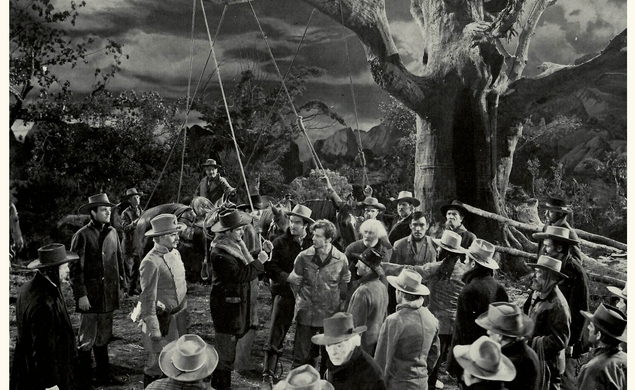
I just watched “The Oxbow Incident,” a cowboy movie about an angry mob that hunts down three innocent men and hangs them before there’s a chance for a fair trial. In one scene the posse agreed to “vote” and anyone who wanted to wait for a trial before hanging these men could step away from the crowd.  Out of fifty people, only seven men stood apart to defy the group. Others in the crowd looked a little ashamed but they didn’t have the courage to walk away. And so the men, who turned out to be innocent, were hanged.   

Oxbow Incident

By the way, the man they thought had been killed wasn’t dead after all. He’d just been out of town.  He walked into the saloon to greet the astonished crowd at the end of the movie. They had killed those men based on a rumor.

I’ve been observing crowds all my life, usually in churches. I’ve seen crowds get sad, anxious, giddy, angry, reactive, and just plain stupid. People who were generally thoughtful as individuals could lose their ability to think for themselves when influenced by a crowd.

Preachers, performers, and politicians know how to influence crowds, using different skills, such as humor, anger, a loud voice, etc. A skillful leader can tap into the angst or general excitement in order to stampede the crowd into doing what he wants. 

I have some of those skills and I tried to be careful that I didn’t manipulate my churches with them.  I had other colleagues who were careful, too.  But I also saw preachers who used those skills unscrupulously.  Some liked to machinegun Bible verses at people, not giving them a chance to breathe. Some screeched, cried, sang, and even babbled. And they could get many people to respond at the end of the service by having them come to the altar call, or perhaps write a bigger check for the collection plate.     

I see people getting lost in other crowds, too, such as at sports gatherings, where they are reactive rather than thoughtful.  A  athlete’s exciting performance,  or how well a play is executed, or a ref’s call… can make the crowd’s mood change instantly.  It scares me when they roar inarticulately in protest or approval. I wonder if anyone is thinking at that point, and I usually leave if I can.

And then there’s politics.  I’m not over the last presidential election and in two years we’ll have another.  I don’t like the guy that got elected.  He uses bravado, ridicule,  and taps into people’s fear and anger to move them. But while I may not like him, I’m even more disturbed by others  who try to stampede the masses both for and against him.

It’s probably too much to ask for, but I wish both sides would calm the heck down, talk reasonably, and make deliberate decisions.  

But maybe before we got out into the crowds, just you and I could agree to stay in control of our minds and be responsible for our thoughts and feelings. If someone comes out screaming that the sky is falling and everyone else goes crazy, you and I could look at each other and quietly remind each other that we choose not to play. We’ll think our own thoughts, make our own decisions and do our best to tune out the craziness.  Then as reasonable humans, we can discuss our differences and work out a plan of action. 

Most people will be slaves to the crowd. But you and I… we could stand apart, couldn’t we? 

Reactions

“I was a minister for a long time,” I say, “but I left because I don’t believe in God anymore.”

Inevitably, this happens in the polite “getting know you” part of the conversation.  If I try to avoid saying it, it just gets it more awkward, so I come right out with it.  

I thought about inventing a different backstory:  I was a pirate…  Or I’m in the Protected Witness Program…  Or I bumped my head and don’t remember anything… by the way, are you my mommy?

I guess not.

People are gracious about it, even if they’re shocked.  No one has challenged me to fisticuffs, pistols, or dueling Bibles. However, they really don’t know what to say and I guess I still don’t either.

I remember one guy I encountered at the library. We’d had just gotten into the introductions when he asked what I did for a living.  He became so quiet when I told him that I could almost hear the gears whirring in his head as he considered his words: Don’t blow it!  This is my big chance to reclaim one of God’s lost lambs. Is there a verse I can quote?

I suggested he relax and tell me about his work (he was a minister). 

Some will invite me to their church, assuring me that theirs is different from all the others, which I doubt is true. In any case, I’m not going to go, but I usually respond with a quiet thank you. 

A lot of people ask me if something happened, perhaps a loss or illness, etc.  I consider the loneliness, depression, and confusion I’ve experienced.   One thing…?  

“Not really,” I answer.  

Some have said, “Maybe God is not through with you yet.”

This is where a flash of anger goes through me and I want to say, “Let me be clear. If your God exists, I’m through with HIM!” But they didn’t intend to be hurtful so I offer a nod and a pleasant smile.  

One guy lit up when I told him I no longer believed. He took it as a challenge to win me over, and so he “witnessed” to me, telling what God had done in his life.  I don’t think he took a breath for two hours.  He nearly wore me out before I could get away. 

Some people feel guilty, like they’re responsible for my “fall.” Again, I have to tamp down the initial angry response.  “I didn’t fall and I’m not lost. You didn’t cause this. I make my own decisions.”  

I usually just say, “It’s okay. It’s not anyone’s fault.”  

Then there are those who become afraid after I tell them. Mostly, their fear is wordless but they say enough to indicate they’re frightened about all they would lose  if I’m right and they’re wrong. I feel bad for them and I try to reassure them. I might reach out to pat them on the shoulder like I would have when I was a minister.  “It’s okay,” I say, “I’m not trying to win you over to my side.” But most of the time I can’t be reassuring enough and they slip away out danger.  

This discussion makes us all tense. I haven’t found a smooth way to get into it, even when I’m simply introducing myself.  I guess the first lesson is for me to get more comfortable with myself.  Then maybe I’ll be able to help others feel more comfortable around me. Even if I can’t, I’ll still feel be more relaxed.

Can’t We Still Be Friends?

Religious belief is not a matter of intellectual choice or emotional attachment.  For most of us it’s a powerful legacy passed on to us and it’s not easy to leave.  However, when we do, we leave behind a community which can include profound friendships, parents, siblings, grandparents, cousins, spouses, and even children.

I did not experience the angry exchanges as other newly outed atheists have.  People were gracious to me. I wasn’t fired from my job. I voluntarily left my career.  But many people I have known and loved the longest have faded away.

It’s understandable enough. Our paths take different directions that can separate us.  I don’t work alongside them, anymore.  I relocated so I don’t run into them at the supermarket.  But there’s no denying that many have chosen not to engage with me anymore.

A few stayed with me. They know who they are and I appreciate them.  I also think many people keep a quiet watch over me but they can’t appear too friendly without risking their other relationships. I get that, and I sympathize. 

Of course, breaks in relationships are often messier than I just described.  I look back and see real mistakes I made that contributed to some of my losses.  However, it’s clear to me that I’ve lost people because I no longer share their religion.

I was hoping I could have my own thoughts, express my views, and even debate them strenuously, yet stay friends. Is that possible? I still love these people and would never reject them. In fact, I’m still here for them.