
Evolution and Those Left Behind

I’ve had a recurring nightmare for the last three years: 

The water is deep and after struggling to stay afloat for a long time, I’m about to drown. I see land in the distance. With what little strength I have left, I swim for it.  I don’t think I can make it but somehow I do.

I crawl onto the shore and feel glad to be alive. But then I hear cries for help. I look back to where I had been and see that I left others behind and they still struggle against the deep. 

I shouldn’t have left them. I should dive back in and go get them but I can’t because I am so tired and I can’t survive going out to the deep again.

I wave my arms and yell out to them. “There’s land here!  Swim this way!”

Some don’t hear me. Others hear but refuse to move.  Nevertheless, they continue to cry for help.

I’m out of my mind because I can’t help them.  I should leave and press further inland to explore but I can’t just walk away and leave them behind.  So I sit on the shore and weep as I listen to them cry out.  

And that’s when I wake up.

I still love the people of the church. I cared for them my entire life.  I visited the hospitals, sat with the dying, comforted the grieving, and counseled the troubled.  I helped them when they were in a jam, celebrated with them during happy times, led them to acts of service, and taught them to the best of my ability.  

I didn’t want to leave them behind but I couldn’t be like them anymore.  I assumed that they wouldn’t want me in their lives if they knew how much I’d changed. Some did cut me off. Others haven’t but they don’t know what to do with me. 

Many scientists say that humans come from creatures who lived in the sea and at some point in time, they came up out of the water to live on land.  Maybe that’s what I’ve done mentally—evolved. 

I think it’s fair to say that everyone is evolving at their own pace in their own direction.  Maybe my nightmare is wrong and no one is really drowning but simply making their own way.

And maybe we’re not so far apart that we can’t still engage with each other.  You know: talk… encourage… criticize… challenge… help… even argue. 

Some people hope that I’m going to come back to their religion, but I’m hoping they’ll come forward and join me where I am.  Maybe none of us will change but is there a context where we can talk reasonably? I admit it’s a struggle but isn’t it possible? 
Atheism Versus the Easter Bunny

Referring to a prominent atheist, the Christian comedian would say,

“Hey, I don’t believe in the Easter Bunny but I don’t make a career out of it.”

The Baptist performer made his career traveling the world using his funny stories as a tool for evangelism.  He was, and still is quite effective, with his blend of humor and pathos and I used to think his line about the Easter Bunny was funny.  

But let’s turn this around a bit and say, hypothetically, that instead of God, the comedian believed in something silly, like… the Easter Bunny, and made his career out of that belief.  What if he performed all over the country basing his message on this belief? 

And what if, when challenged, he took on a serene, sanctimonious look as he gave his witness: 

“I know it’s true,” he might say, “because I feel the Easter Bunny in my heart.  My parents taught me it was true and I still get a warm feeling when I sing the sweet childhood songs that proclaim the power of the Bunny.  I meet regularly with others to have special Bunny Study Groups and we encourage each other when our doubts haunt us.  Plus, once when I was hunting Easter eggs I had almost given up hope but then the Spirit of the Bunny spoke to my heart and showed me where I could find some—and I did! More than my basket could hold! So don’t tell me the Bunny isn’t real!” 

What if billions of people said the same thing? 

In that context, I think I could understand how someone might choose to make a career arguing against the existence of the Easter Bunny.   

Sure, it’s a silly scenario.  However, billions of people actually do profess a belief in a deity they have never seen, heard, or smelled, and they use the same, uh, reasoning to justify their belief.  And so, yes, some of us resist the concept although we rarely make a living from doing so.

Someone might ask me, “Why make things so unpleasant by arguing? Why not go on with your life and let people believe as they do?  Why can’t we all have mutual respect for each other?” 

Mutual respect sounds pretty good to me, and it would be a great starting place.  We could all be quiet and let everyone have their own thoughts.

So how about this:

I’ll get quiet when the Evangelical Christians do.  When they stop their global campaign, I’ll stop writing and talking.  I’ll stop speaking up when they stop trying to condition the minds of little children with songs, stories, and threats.  When they quit trying to force the schools and the government to carry their message for them, I’ll stop protesting.

Many Christians accuse atheists of having a hidden agenda, which I think takes a special blend of nerve and insanity, considering that their highest priority is to convert the entire world.

By the way, there’s nothing secret about the atheist agenda.  Simply stated, we won’t be forced to believe in God.

It may not be much of a career but it’s a powerful cause.  

Standing Apart from the Crowd

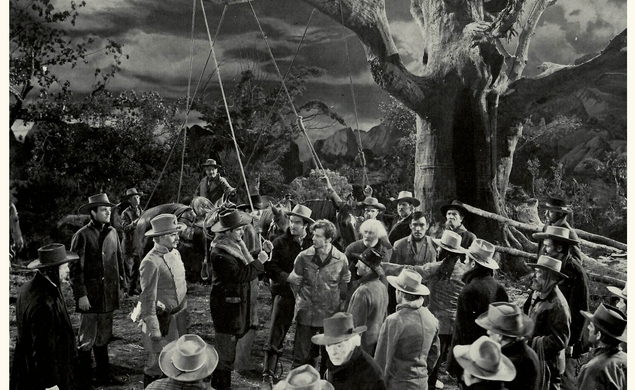
I just watched “The Oxbow Incident,” a cowboy movie about an angry mob that hunts down three innocent men and hangs them before there’s a chance for a fair trial. In one scene the posse agreed to “vote” and anyone who wanted to wait for a trial before hanging these men could step away from the crowd.  Out of fifty people, only seven men stood apart to defy the group. Others in the crowd looked a little ashamed but they didn’t have the courage to walk away. And so the men, who turned out to be innocent, were hanged.   

Oxbow Incident

By the way, the man they thought had been killed wasn’t dead after all. He’d just been out of town.  He walked into the saloon to greet the astonished crowd at the end of the movie. They had killed those men based on a rumor.

I’ve been observing crowds all my life, usually in churches. I’ve seen crowds get sad, anxious, giddy, angry, reactive, and just plain stupid. People who were generally thoughtful as individuals could lose their ability to think for themselves when influenced by a crowd.

Preachers, performers, and politicians know how to influence crowds, using different skills, such as humor, anger, a loud voice, etc. A skillful leader can tap into the angst or general excitement in order to stampede the crowd into doing what he wants. 

I have some of those skills and I tried to be careful that I didn’t manipulate my churches with them.  I had other colleagues who were careful, too.  But I also saw preachers who used those skills unscrupulously.  Some liked to machinegun Bible verses at people, not giving them a chance to breathe. Some screeched, cried, sang, and even babbled. And they could get many people to respond at the end of the service by having them come to the altar call, or perhaps write a bigger check for the collection plate.     

I see people getting lost in other crowds, too, such as at sports gatherings, where they are reactive rather than thoughtful.  A  athlete’s exciting performance,  or how well a play is executed, or a ref’s call… can make the crowd’s mood change instantly.  It scares me when they roar inarticulately in protest or approval. I wonder if anyone is thinking at that point, and I usually leave if I can.

And then there’s politics.  I’m not over the last presidential election and in two years we’ll have another.  I don’t like the guy that got elected.  He uses bravado, ridicule,  and taps into people’s fear and anger to move them. But while I may not like him, I’m even more disturbed by others  who try to stampede the masses both for and against him.

It’s probably too much to ask for, but I wish both sides would calm the heck down, talk reasonably, and make deliberate decisions.  

But maybe before we got out into the crowds, just you and I could agree to stay in control of our minds and be responsible for our thoughts and feelings. If someone comes out screaming that the sky is falling and everyone else goes crazy, you and I could look at each other and quietly remind each other that we choose not to play. We’ll think our own thoughts, make our own decisions and do our best to tune out the craziness.  Then as reasonable humans, we can discuss our differences and work out a plan of action. 

Most people will be slaves to the crowd. But you and I… we could stand apart, couldn’t we? 

The UMC Is Up At Bat

The United Methodist Church is ripping itself apart over how they will regard members of the LGBT. Because I was a United Methodist Minister for a long time, I have an interest in the direction they will choose, and so I have repeatedly expressed my views and urged them to be fully inclusive.

Before I say anything else about them I should note that at least the UMC is grappling with the issue. The Southern Baptists aren’t . The Assemblies of God aren’t. The Latter Day Saints aren’t. All the little independent fundamentalist churches aren’t.

They’re still intact with their love-the-sinner-hate-the-sin motto. They’re still taking cold comfort in their righteous indignation. They’re still spreading anxiety with a false notion that a people that make up less than five percent of the population are taking away our rights, corrupting everyone’s morals, and causing God to inflict natural disasters on all of us.

So I appreciate the UMC for struggling over this. Sometimes I complain because it’s taking so long but they’re further along than many other Christian organizations. I would love to see the UMC lead the rest of Christianity in taking a small step forward in showing dignity and respect to an oppressed minority.

They are up at bat while the other churches haven’t even made it to the ball field.

man holding baseball bat
Photo by Tim Eiden on Pexels.com

One of My Biggest Regrets

They’d never seen me mad before and it startled everyone in that church board meeting.  I’d raised my voice and threatened to quit, which I thought was quite restrained of me considering that I wanted to rip the tables and chairs out of my path to put my hands on the guy who had just spoken critically of my wife.

I later apologized for my anger but every week when I saw that guy in church, I had to resist the urge to grab him by the lapels, pin him to the wall, and express my feelings.

It was several years ago and my former wife and I have gone our separate ways. However, I still feel a bitter rage wash over me when I think of that moment.  To be fair, my anger is not from that one instance and it’s not just at that one person (although I hope never to see him again).

One of the biggest regrets I have is how much I expected my family to contribute to my professional ministry.  I made my kids come to the church activities and I pressed my spouse into service.  Whenever I went to interview for a new job, my family had to be interviewed too.

I was raised in a minister’s home and so I never thought it inappropriate for a church to have expectations of the preacher’s family.  But it was pointed out to me recently that no other organization can expect an employee’s family to participate in his or her profession.

A few of my churches treated my wife and children decently but most of the years were grim for the family, where they were used up with little recognition. I’m angry at myself for allowing it.  If I had it to do over, I would tell my family that I did not expect them to participate in any church activities—worship, classes, potlucks, VBS, etc—unless they wanted to.  And I would tell my church leadership not to expect anything of them.

To all my minister friends, I encourage you to do what I failed to do and protect your families. Release them from obligation to participate in your profession with you.


See David Mercer’s new website:  damercerlife.com


I Won’t Stay Quiet

David, you’re hurting the church.  Why can’t you just be quiet?

I’ve been told all my life to be quiet for the sake of the church. Sure, I can preach, teach, guide, and help. But don’t challenge anyone or ask questions or express doubts because it hurts the church and I’ll go to hell Plus I could lose my job.

How do my words hurt anyone? The church claims to be an instrument of truth. How do people find truth if they are not allowed to ask, seek, and knock? Is the institution really so fragile that it can’t handle my voicing my thoughts?

When I was a young preacher in the churches of Christ, they taught that instrumental music in worship was evil. I thought it was ridiculous but I had to be careful with my words or I could lose my job. Later, I learned to refrain from voicing a dissenting opinion on baptism in the United Methodist church because I wanted to keep my job. For the same reason, I also kept quiet about much bigger issues, including our relationship with the LGBTQIA.

Yet job security was rarely mentioned. Instead, we spoke of how damaged the church could be if we even brought up these subjects. It’s interesting that an institution with the power to affect my life so dramatically could be so fragile.

Now, I’m still being urged to stay quiet. But I’m not going to. Silence makes us sick. It can even kill. I always wanted to be a healer so I’ll continue to speak up.

I’ll try to be respectful and reasonable. Just not quiet.

No More Church Buildings

Could I make a suggestion to churches? Get out of the property business.  

I mean it. Every small town I lived in has heavily mortgaged unused gyms and half filled sanctuaries and I’ve been seeing them since I became a minister in the 1980s. 

Let me say this as clearly as I can:

NEW BUILDINGS MAKE CHURCHES SMALLER.

And if your church is struggling, a new building could kill it. But even if it survives, all its other ministries are curtailed in order to pay off the debt.

I have walked through many empty buildings and felt my bile and blood pressure rise as my footsteps echoed across the floors of empty meeting rooms.  I would  pass through the kitchens and think of gossip sessions and turf battles waged as casseroles and fried chicken were prepared.  In the hallways, expensive stained glass images stared down at me while I glared up at them. 

Meanwhile, within sight of those buildings, people were going hungry. Neighborhood churches could have fed them for years with the money they had tied up in property.     

 “But we’re in the business of saving souls,” they protest.  And I say no they’re not.  Buildings do not tend to the souls of people. Do a little counting and see that while the property values go up, the number of people attending church goes down. 

“But the church down the street is doing well and they have a nice church building.”  Assuming it’s correct that the church is doing well, they didn’t become successful because of the building. They built the building to accommodate their success.   And I say they shouldn’t have built the building anyway.

Perhaps Christians could become more tolerant of different religious styles and learn to worship together in bigger groups. They could combine their resources to do actual work–Christ’s work, presumably.    

Jesus told the rich young man, “Sell everything you have, give the money to the poor, and follow me.” Perhaps in the spirit of that command, churches could sell off their properties and use the money to actually work for their God.

The focus should be on people not property.

Charlottesville–What Do I Say?

Is it possible to be both shocked and unsurprised that neo-nazis can stand up in America to say murderous things about people?

I want to say to the white supremacists, “Yes, you have the right to say what you think and so do I. So I also want to say, “You should be ashamed. Shut the hell up!”

I want to say to the President, this is your moment! Speak up for truth and justice. Get on that twitter you love so much and let em have it. Stand up and direct your reckless, angry sentiments at the people who deserve it. Show us what it should really mean when you cry, “America first!”  

I preached to white southern American churches all my life, and I’m pretty sure what will be said this morning in many of them. Some will want to speak up for their statues and flags. Others will protest that they never were actually racist. Others will criticize minorities for being so angry. And only a handful will lament that racism is still so rampant after all these generations. Others will agree while trying to temper the mood.

And in dark corners of the church building people will swap racist jokes.  Tell me you aren’t one of those people and I’ll believe you, but it still happens.

I’d rather promote healing over shame.  Maybe we could talk about how we could help the people in Charlottesville. We could talk about acknowledging the suffering of minorities and how we could promote healing. We could discuss what to do to stem the hatred that has bubbled to the surface.

And to those who want to crack jokes—I want to say that’s your right but could you do it away from the place where others worship Jesus?

So About Church Politics….

If by politics, we mean communicating, negotiating, and even persuading each other… well, those are good things.  It makes sense to engage in them because a church depends on people working together in a mature, respectful fashion.  In the best circumstances, there can be disagreement, flared tempers, and hurt feelings but they are resolved when people practice open, caring communication.

However, when we speak of church politics, we usually refer to those who gossip and manipulate to get their way. Some are looking to impede change. Others entertain themselves by assassinating the reputation of persons.  Then there’s that special cadre dedicated to undermining the preacher with the ultimate goal being to get rid of him or her. Sometimes these people cling to leadership positions; others prefer to stay hidden, doing their work with whispered conversations.

Much as I wanted to, I couldn’t ignore them.  I also couldn’t negotiate with them because they couldn’t tolerate the openness of honest discussion. As a result, I spent too much energy protecting myself and others.  It was easier when leadership protected me but that meant they couldn’t focus their energy on anything else either.

Every church I’ve known since childhood has this dysfunctional element. Every minister I know describes similar dysfunctions. No wonder membership continues to decline–although they’re not the only reason for it.

To the surviving handful of people who tried so hard to get rid of me over the last three decades, feel free to claim your victory. Congratulations… I’m out.  However, I didn’t leave because of you.

I’m out but I’m not done. I have more to say.